Every spring, New Jersey homeowners discover something unsettling: damage they never saw coming. A pile of coarse sawdust near a deck beam. Perfectly round holes bored into a porch railing. Large black ants trailing across the kitchen floor in January. By the time these signs appear, wood-destroying insects have often been at work for months — sometimes years.
Two insects are responsible for the vast majority of wood damage in New Jersey homes: the carpenter ant (Camponotus pennsylvanicus) and the carpenter bee (Xylocopa virginica). They look different, behave differently, and require different treatments — but they share a critical trait: they are both far more destructive than most homeowners realize until the damage is already expensive.
This guide explains exactly what each insect is, how to tell them apart, what damage they cause, and why professional treatment is the only reliable solution for NJ properties.
What Carpenter Ants and Carpenter Bees Have in Common
The word "carpenter" is the key. Both insects use their mandibles to excavate solid wood — not to eat it, but to live inside it. This is what sets them apart from nearly every other pest: they don't damage wood incidentally, they need wood as a nesting material. That's also what makes them structurally dangerous over time.
Both species are native to New Jersey. Both are most active April through August. Both are attracted to moisture-compromised or weathered wood. And both infestations get significantly worse if left untreated, because each season's damage creates the perfect conditions for more damage the following year.
That's where the similarities end. The biology, nesting behavior, and treatment protocols for these two insects are completely different — and confusing them leads to the wrong treatment approach.
Carpenter Ants: The Colony Threat Inside Your Walls
What They Are
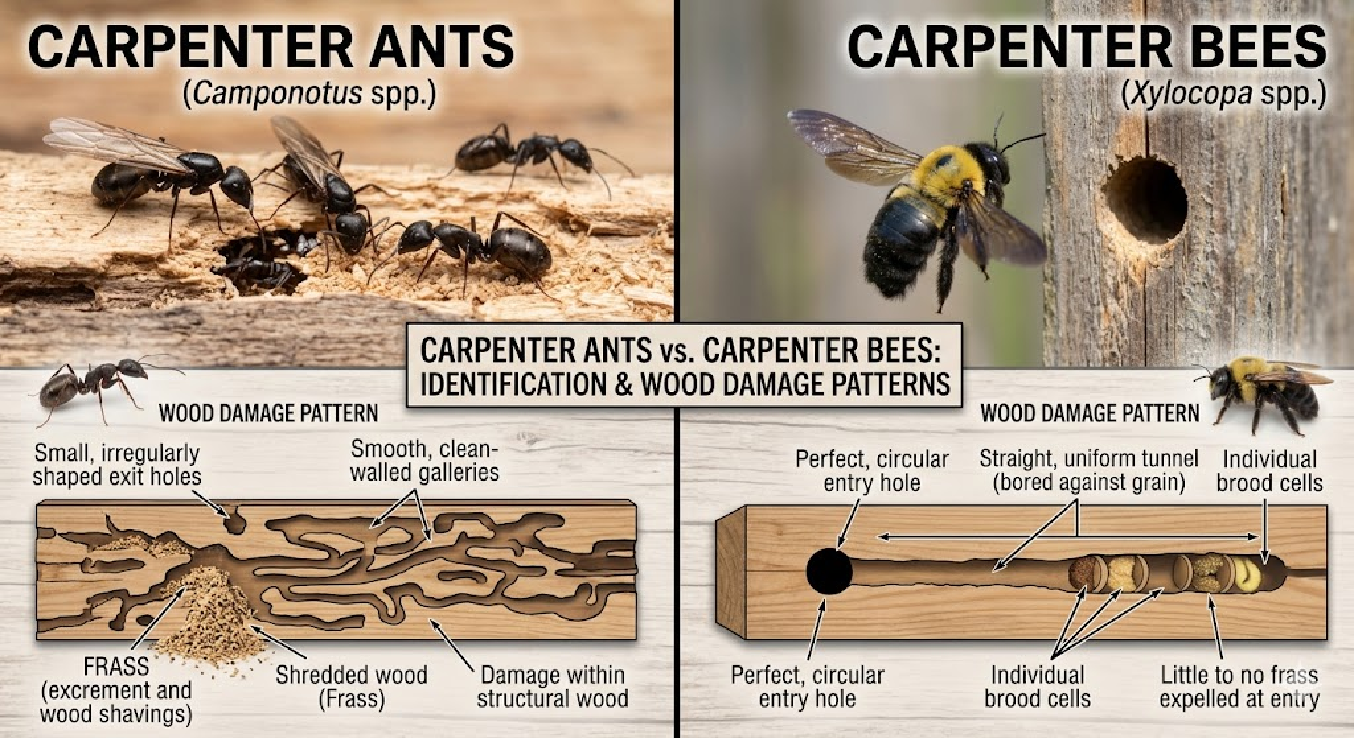
The Eastern Black Carpenter Ant (Camponotus pennsylvanicus) is the largest ant species commonly found in New Jersey homes. Workers range from 6 to 13mm and are uniformly black. Unlike termites — which consume wood cellulose — carpenter ants excavate galleries through soft or moisture-damaged wood to create nesting chambers, ejecting the wood as coarse frass that looks like pencil shavings.
A mature carpenter ant colony contains 10,000 to 20,000 workers and is led by a single queen who can live 10 to 25 years. The colony maintains two types of nests simultaneously: a parent colony almost always located outdoors in decaying wood (a stump, hollow tree, or buried timber near the foundation), and one or more satellite colonies inside the home, where workers shelter in wall voids, floor joists, or sill plates.
Why They're So Difficult to Eliminate
This two-colony structure is why carpenter ant infestations are so frequently mishandled. The satellite colony inside your home is what you see — the trailing workers, the frass deposits, the rustling sounds in the walls. But the queen is never inside. She's in the parent colony outdoors, continuously producing new workers. Treating only the interior satellite colony kills the workers you can see and does nothing to stop the infestation. Within weeks, the queen repopulates the satellite nest.
Effective carpenter ant control requires locating and treating both the outdoor parent colony and all indoor satellite colonies simultaneously — a job that requires professional inspection, not a can of spray.
The DIY Problem
Most over-the-counter ant sprays contain repellent pyrethroids (permethrin, bifenthrin). When carpenter ants detect these chemicals, they don't die — they reroute. The colony fragments and often establishes new satellite nests deeper inside the structure. This is why so many homeowners report that carpenter ants "came back worse" after a DIY treatment. Professional treatments use non-repellent actives that workers unknowingly pick up and transfer back to the colony through trophallaxis (food sharing), eventually reaching the queen and brood.
The Seasonal Red Flag You Shouldn't Ignore
Finding carpenter ants indoors in winter is one of the most important warning signs a New Jersey homeowner can encounter. Outdoor colonies are dormant when temperatures drop. If you're seeing large black ants inside your home in January or February, they're not coming in from outside — they're living in a satellite colony inside your heated walls. That requires immediate professional treatment, regardless of season.
The other critical signal: winged carpenter ant swarmers appearing indoors in May or June. Alates (winged reproductives) are only produced by colonies that are 3 to 6 years old with at least 2,000 workers. Finding them inside means an established, mature colony is already in your structure.
What the Damage Looks Like
Over multiple seasons, carpenter ant galleries can extend several linear feet through structural lumber — sill plates, floor joists, wall studs, rim boards, and roof sheathing. A colony that has been active for five or more years can compromise multiple structural members, requiring repairs that cost far more than professional extermination would have. Early treatment is always the better financial decision.
For homeowners in Central New Jersey, Environmina Pest Control's carpenter ant exterminator in NJ service is led by a licensed chemist and toxicologist who approaches every job by tracing foraging trails to their source — both the satellite colony inside and the parent colony outside — using professional non-repellent treatments and direct nest injection to achieve complete colony elimination. Every treatment is backed by a 1-year warranty, the longest offered by any carpenter ant exterminator in New Jersey.
Carpenter Bees: The Silent Structural Driller
What They Are
Carpenter bees (Xylocopa virginica) are large, robust bees — about ¾ to 1 inch long — that are frequently confused with bumblebees. The fastest way to tell them apart: look at the abdomen. Carpenter bees have a smooth, shiny, solid black abdomen. Bumblebees have a fuzzy, yellow-and-black striped abdomen. If you see a large bee flying aggressively in and out of a hole bored into a wooden surface — that's a carpenter bee.
Carpenter bees are solitary, not colonial. Each female drills her own gallery — a precisely circular ½-inch tunnel that runs with the grain of the wood — to create individual brood chambers for her eggs. They strongly prefer soft, unpainted, weathered wood: cedar and pine decks, fascia boards, pergolas, porch railings, and barn wood are the most common targets in NJ homes.
Why They Come Back Every Year
Carpenter bees overwinter inside their galleries and return to the same sites each spring. Year after year, females expand existing tunnels and drill new ones alongside them. What starts as a handful of entry holes in year one becomes a branching network of tunnels several feet deep by year three or four, significantly weakening the structural integrity of the affected wood members.
This annual recurrence is the reason sealing old entry holes — without treating them first — is counterproductive. Bees will drill new entry holes directly alongside any plugged openings if the underlying attraction hasn't been eliminated.
The Woodpecker Problem Nobody Mentions
One of the most destructive consequences of an untreated carpenter bee infestation in New Jersey is secondary woodpecker damage. Downy and Hairy Woodpeckers — both common across Middlesex, Somerset, and Union Counties — can hear the vibration of developing carpenter bee larvae inside gallery tunnels. They will systematically excavate large, jagged holes along fascia boards and wooden siding trying to reach the larvae. This secondary damage is often far more expensive to repair than the original bee galleries and can extend damage across the entire surface of an exterior wall.
Eliminating the carpenter bee infestation before larvae develop is the only reliable way to prevent woodpeckers from targeting your home.
Do Carpenter Bees Sting?
A common question — and the answer surprises most homeowners. Male carpenter bees cannot sting. They have no stinger. They will hover aggressively near their nest and dive-bomb people who get too close, which is alarming, but physically harmless. Female carpenter bees do have a stinger, but they are non-aggressive and almost never sting unless handled directly. The real risk from carpenter bees is entirely structural, not personal.
Treatment: Why Surface Sprays Don't Work
The most common mistake in carpenter bee treatment is applying a surface spray to the entry hole and stopping there. Surface sprays reach the first inch or two of the gallery opening. Carpenter bee galleries can extend 12 to 18 inches deep, with multiple chambers branching off the main tunnel. Any bees or larvae deeper in the gallery are completely unaffected.
Effective carpenter bee treatment requires a two-step process: professional-grade liquid insecticide injected deep into each gallery for immediate knockdown of active bees, followed by insecticidal dust applied inside the gallery. The dust adheres to the tunnel walls and remains active for weeks, killing larvae, newly emerging adults, and any bees that attempt to reuse the gallery after the initial treatment. Gallery sealing is then done in late fall — once all activity has clearly stopped — to remove the nesting site permanently.
Environmina Pest Control's carpenter bee exterminator in NJ service uses exactly this two-step liquid-and-dust gallery injection protocol, backed by a full 1-year warranty. If carpenter bees return to treated areas within 12 months, they return and retreat at no additional cost.
Carpenter Ants vs. Carpenter Bees: A Quick Comparison
Carpenter AntCarpenter BeeSpeciesCamponotus pennsylvanicusXylocopa virginicaSize6–13mm19–25mmSocial structureColonial (10,000–20,000 workers)SolitaryNestingExcavates galleries in soft/moist woodDrills circular tunnels in soft/weathered woodEvidenceCoarse frass, rustling in walls, large black antsRound ½" entry holes, sawdust piles, hovering malesActive season (NJ)April–October (indoors year-round)April–AugustDIY failure modeRepellent sprays fragment the colonySurface sprays miss deep gallery areasPrimary riskStructural damage to framing, joists, sill platesStructural damage to exterior wood, secondary woodpecker damageTreatment approachNon-repellent actives + direct nest injection (both nests)Liquid + dust gallery injection + fall sealing
When to Call a Professional
Both insects follow predictable patterns that give homeowners clear decision points:
Call a professional immediately if you see:
Large black ants indoors during winter (carpenter ant satellite colony confirmed)
Winged ants indoors in May or June (mature, established carpenter ant colony)
Coarse sawdust piles near baseboards, sill plates, or structural wood
Round ½-inch holes in deck boards, fascia, or railings with fresh sawdust beneath them
Woodpecker damage on your siding or fascia (active carpenter bee infestation underneath)
Rustling or chewing sounds inside walls at night
Don't wait because both insects cause damage that compounds year over year. The cost of professional treatment is always lower than the structural repair costs that follow a multi-year untreated infestation.
Why NJ Homeowners Choose Environmina for Wood-Destroying Insects
Most pest control companies treat what they can see. Environmina is New Jersey's only chemist and toxicologist-led pest control service — every treatment protocol for both carpenter ants and carpenter bees is built on formulation chemistry, not just standard industry practice. That's what makes it possible to back both services with a full 1-year warranty, the longest available from any NJ exterminator.
With a 4.9-star rating across 219 + verified Google reviews and same-day service available 24/7, Environmina serves Middlesex, Somerset, Essex, Union, Hudson, Hunterdon, and Warren Counties.
Free inspection. Transparent pricing. Science-backed results.
📞 Call (848) 482-0479 or schedule online at environmina.com