Coastal décor has changed. It used to mean framed seashell prints or a driftwood mirror above the mantel. Navy stripes, rope accents — classic, charming, familiar. But a new generation of homeowners wants more. More immersive. More personal. More alive.
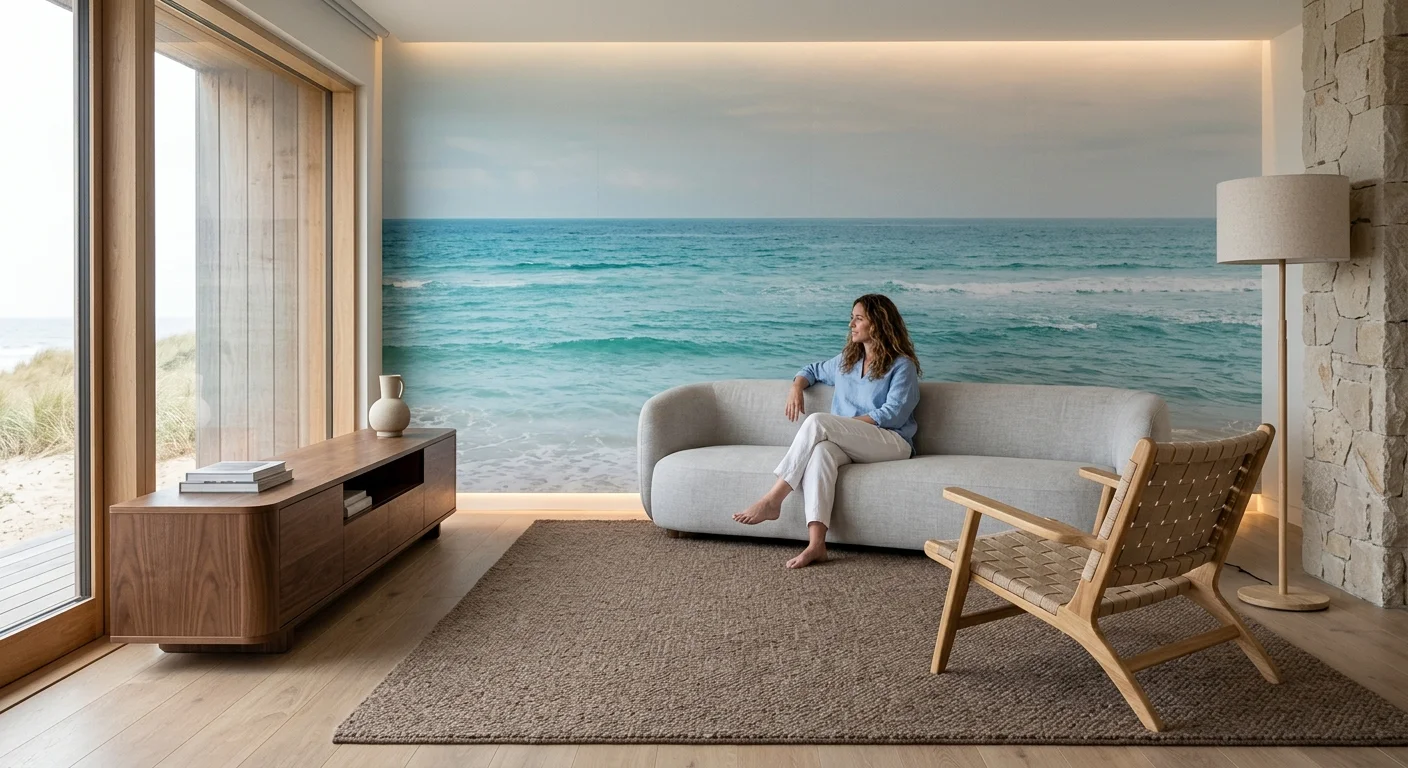
Custom wall murals have become the most powerful tool in ocean-inspired interior design. With the precision of a professional wall printer, a single mural can turn an ordinary living room into a space that feels like standing at the water's edge. No gimmicks — just a full, breathtaking view printed directly onto your surface that pulls you in.
Redesigning a beach house? Craving that salt-air calm in a landlocked apartment? This guide shows you how to do it well — with style and intention.
Something quiet happened to coastal design. Not a dramatic overhaul — more like a slow exhale. The anchors came down. The rope vanished. Something far more interesting took their place.
The 2026 coastal aesthetic isn't a style so much as a feeling — warm, textured, personal. WGSN named Transformative Teal as their Color of the Year. But even that color arrives softened, pulled toward sea-glass rather than saturated aqua. It's a hint, not a statement. That restraint is a choice, not an accident.
The old palette is fading out. Crisp white walls, cool nautical blue accents, bleached cerused wood — all giving way to something richer. Deep navy now layers into warm neutral schemes, showing up in about 70% of refined coastal interiors. Sand, caramel mist, and driftwood taupe take over as the main background tones, covering around 40% of the palette. Soft sage greens sit at a muted 20–30% saturation. Sun-baked terracotta appears at around 15% — just enough to feel grounded without taking over.
Homeowners used to grab themed accents. Now they reach for layers instead. Linen, jute, rattan, reclaimed wood, microcement, recycled glass — these materials carry the coastal story without saying it out loud. A jute rug, 100% natural fiber, grounds a room. Bamboo furniture adds structure and warmth.
Surveys back this up. 75% of homeowners now prefer organic, unthemed atmospheres over coastal-themed spaces with obvious decor. Blue covers just 10–15% of surface area in the new coastal interior — controlled, intentional, never overpowering.
The ocean inspires the room. It doesn't decorate it.
There's a specific kind of disappointment that comes with peeling wallpaper. Try to bring a seascape into your home through traditional rolls and paste, and you'll know it fast.
The seams show. The edges lift. A wave breaks across one panel — then breaks again six inches to the right, where the next strip begins. The ocean, interrupted. The illusion, lost.
Wall printing fixes this at the root.
Traditional wallpaper — non-woven or vinyl — is a tiling system. It was never built for continuous, photorealistic imagery. A visible seam on a repeating floral pattern? Forgivable. On a coastal mural — where the whole point is an unbroken horizon, water flowing from one end of the room to the other — a seam kills the effect.
Direct wall printing delivers 100% seamless motifs from first to last inch. No overlaps. No lifted edges. No bubbles forming six months later as humidity shifts.
The ocean doesn't have edges. Your mural shouldn't either.
Here's a number worth sitting with: up to 4 meters in height, printed in a single uninterrupted pass. That's the full vertical range direct wall printing can cover. Floor to ceiling, corner to corner, one accent wall — no joins breaking the image.
Wall printing doesn't negotiate with scale. It works at whatever size your room demands — full stop.
Textured plaster. Raw concrete. Woodchip walls. Exposed brick. These surfaces give a space real character — the kind that feels earned, not staged. They also defeat traditional wallpaper outright. Adhesion fails. Bubbles form beneath the backing. The paper lifts before the paste even cures.
So for beach house interiors with genuine texture and history, this difference is huge.
Traditional coastal decor faces a relentless enemy: the environment itself. In high-humidity areas like Sea Isle, the combination of salt air and moisture is a death sentence for wallpaper. Standard cellulose-based papers and water-based adhesives are porous—they act like a sponge, absorbing sea spray and humidity. This leads to the "coastal peel," where edges lift within months, and worse, the dark bloom of mildew and mold growing behind the paper.
Unlike traditional paint or wallpaper, this UV barrier:
For a Sea Isle home, this isn't just about aesthetics; it's about structural integrity. You aren't just decorating a wall; you are arming it against the Atlantic.
The durability gap hits hardest in coastal and beach house settings. Humidity, salt air, and strong light speed up fading and peeling — exactly what wallpaper struggles with. It holds up for decades without the patching and re-hanging cycle that wallpaper always circles back to.
For anyone serious about ocean-inspired interior design that keeps its beauty long-term, the comparison isn't close.
The best coastal rooms in 2026 don't announce themselves. They pull you in — through light, through stillness, through a wall that looks like it's breathing.
Pinterest named Cool Blue its standout color trend for the year, and the timing makes sense. After seasons of bold patterns and saturated statement walls, people are exhaling. They want spaces that feel like a long walk at the shoreline — the kind that slows your heart rate without you noticing. One idea runs through every strong coastal mural concept right now: atmosphere over ornamentation, feeling over theme.
Here's what's worth building around.
1. Calm Water Reflections
Light on water is doing a lot of heavy lifting this year. Murals that capture early morning sun breaking across a still surface — those soft, shifting pools of aqua and pale silver — are selling fast for 2026 through 2027. The space feels open, airy, and restful in a way that a painted wall or framed print can't match.
2. Soft Wave Seascapes — Realism Meets Abstraction
The old photorealistic ocean mural — sharp and a little cold — is giving way to something more layered. The 2026 seascape blends realism and abstraction. You get recognizable wave forms, but rendered in layered blues and softened aquas, with sandy neutrals bleeding in at the edges. It reads as coastal without reading as a photograph.
The Coastal Durability Advantage: Why UV Ink Beats Wallpaper In high-humidity areas like Sea Isle, traditional wallpaper is a sponge for moisture, leading to the "coastal peel" and hidden mildew. Our industrial-grade UV-curable inks create an instant, non-porous shield upon contact.
Ten square meters of ocean — rendered in full, breathing detail — in two to three hours. That's not a promise. That's just what modern wall printing does.
Decorators spend careers trying to close the gap between what a client imagines and what's possible in a weekend. This technology changes that. It doesn't adjust the old process. It replaces it.
A trained operator — someone who picked up the essentials in one to two days, with zero background in fine art — can cover 10 m² in two to three hours. That's one to two full projects in a single workday. For decorators juggling multiple commissions, that output isn't just a convenience. It's a whole new way to run a business.
The only ongoing consumable for direct wall printing is ink. That's it. At 6 to 10 ml per square meter, your material cost comes out to about $0.50 per m². Skilled labor, templates, printing plates, substrate panels — none of those show up on the invoice anymore. The machine recoups the initial investment faster than most decorators expect.
In a competitive vacation rental market like Sea Isle, standing out is a financial necessity. For Airbnb and VRBO hosts, a wall-printed immersive mural is a high-return investment. Data shows that listings with "Instagrammable" feature walls achieve significantly higher click-through rates and can command a premium nightly price compared to standard gray-wall rentals.
For local entrepreneurs and decorators, the business case is even stronger. With a consumable cost of only $0.50 per m², a single coastal mural can be completed in a morning, yet it adds thousands of dollars in perceived value to a property. You’re not just selling a service; you’re providing a high-margin solution for property owners looking to dominate the 2026 rental season.
A professional-grade printing setup that breaks down into five compact packages and fits in the back of an SUV — that's a real shift in how you work. No dedicated studio. No commercial lease. No logistics chain. Just household electricity and an on-site setup.
No part of this process needs a specialist:
UV inks take care of the long term. Fade-resistant, scratch-resistant, moisture-resistant — the mural holds for years with no touch-ups needed. Salt air and humidity wear most things down fast in a coastal setting. This durability isn't a bonus. It's the core reason the investment pays off.
The ocean has always known how to hold our attention — and now, your walls can too.
Coastal decor in 2026 isn't about matching throw pillows to striped curtains. It's about building a space that breathes. One wall can blur the line between your living room and the sea. Custom wall murals — those made with direct-to-wall printing — lead that shift. They offer something no framed print or peel-and-stick sheet ever could: real, full immersion.
Been thinking about an ocean-inspired interior design refresh? Stop browsing. Then find a printing partner who can bring that vision to life with the care it deserves.
The most beautiful home isn't the most expensive one. It's the one that makes you exhale the moment you walk through the door.
Thinking of a coastal refresh or starting your own mural business? Download our '2026 Coastal Wall Printing Tech Specs' or Contact us for a free sample print on your specific wall material.