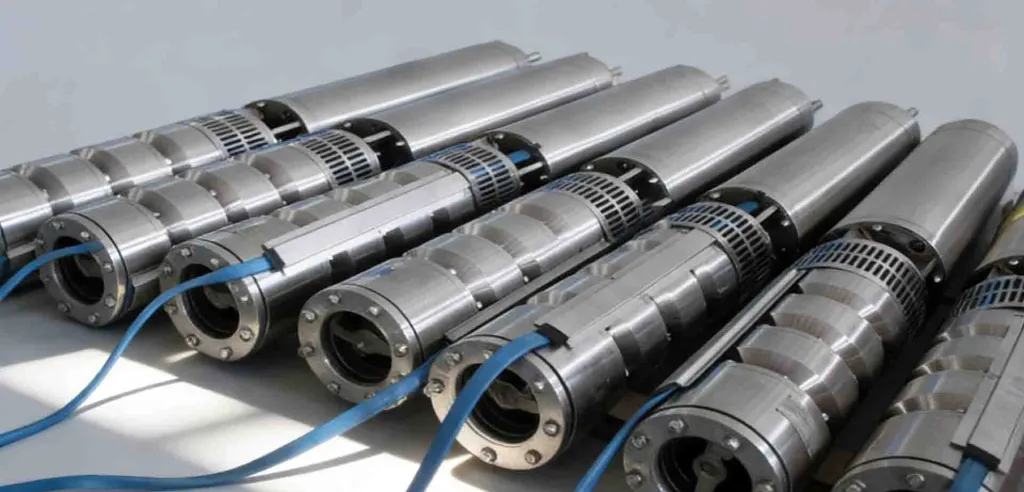
When people are looking for reliable water supply solutions, terms such as deep well pumps and submersible pumps often appear. Although both types of pumps are designed to meet similar water supply needs, they have significant differences in structure, working principle, and application applicability. Learn more about their core traits in this article, where we will compare the design, performance, advantages, disadvantages, and practical use cases of these two pumps to help you make informed decisions and provide clear explanations.
What Is a Deep Well Water Pump?
Deep well water pump is a type of submersible pump,it was mainly used for pumping water from deep wells. It needs to be installed deep in the well and completely submerged in water, effectively lifting water to the surface even from very deep places. It is usually long and narrow, designed in a cylindrical shape, suitable for standard well casing, and widely used in residential water supply, agricultural irrigation, and rural drinking water projects.
Most deep well water pumps are jet pumps or centrifugal pumps. Jet pumps use a mix of suction and pressure from a nozzle to lift water. Centrifugal ones spin an impeller to push water upward. Their design keeps all parts dry and easy to fix. You can see the motor, pipes, and controls without lifting anything heavy.
What Is a Submersible Pump?
A submersible pump is a device that operates completely underwater,it equipped with a sealed motor. It pushes water directly onto the surface of the water instead of sucking it up, making it efficient and quiet to use. Widely used in wells, ponds, sewage and drainage systems, suitable for many water lifting applications.Submersible pumps come in various sizes. Some are suitable for narrow wells, while others are suitable for high-capacity work on farms
Key Design Differences
The design of a pump directly determines its performance and suitable applications. Below we highlight the primary differences between deep well water pumps and submersible pumps.
1.Placement
The deep well water pump is designed can be installed deep in the well casing, and it can be completely submerged in considerable depth of water to obtain groundwater. In contrast, submersible pumps can be placed in various water sources such as ponds, tanks, rivers or sumps, not limited to narrow well structures, and they are more flexible in installation location and depth.
2.Parts and Structure
The deep well pump has a long, narrow, and multi-stage structure with stacked multi-stage impellers, it can achieve high head and is more suitable for thin well casing. Standard submersible pumps typically have a compact single-stage or short multi-stage design structure, it have a wider pump body and greater structural flexibility, suitable for general water delivery rather than ultra-high head applications.
3. Power transmission
Deep well pumps rely on submersible motors, which drive multi-stage impeller components to achieve efficient power transmission even in deep places. Traditional submersible pumps also use sealed underwater motors, but their power delivery is optimized for lifting tasks ranging from shallow to medium, with different torque and hydraulic matching compared to deep well models.
Functional Contrasts
Function covers how well a pump lifts water, handles depth, and saves energy. Let’s check these points.
1. Lifting capacity and depth limitations
The characteristics of deep well water pumps are high head and deep well mining, and their multi-stage structure enables them to operate efficiently in wells hundreds of meters deep. In contrast, standard submersible pumps are designed and built for medium to low head applications, making them more suitable for shallow water sources such as ponds, water tanks, and drainage applications, rather than deep wells.
2. Flow rate and pressure
The characteristics of a deep well pump are high pressure and stable head output. It can push water upwards over a long vertical distance and is suitable for well water supply, usually at a medium flow rate. Standard submersible pumps typically provide higher flow rates at relatively lower pressures and are designed for rapid water delivery, drainage, and circulation in open water environments, rather than height lifting.
3. Energy usage
The deep well pump is used for efficient operation in deep wells, and its motor and hydraulic structure can minimize energy loss during long-distance water lifting processes. Although they require more power to overcome high vertical distances, their design ensures stable and efficient energy use to achieve continuous deep well operations. Conventional submersible pumps typically consume less power under normal operating conditions, as they operate at lower water heads and focus on the economical operation of daily water delivery and drainage tasks.
4. Noise Level
Both pumps operate underwater, so they produce lower noise than surface pumps. However, deep well pumps are installed much deeper underground, with almost no noise transmitted to the surface. Regular submersible pumps, while still quiet, may generate slightly more audible sound near the water surface, especially when running at high flow rates.
Advantages and disadvantages
No pump is perfect. Let's list their strengths and weaknesses
Advantages of deep well water pump
Disadvantages of deep well water
Advantages of submersible pumps
Disadvantages of submersible pumps
How to choose between deep well water pump and submersible pump
The selection of a suitable pump depends on several key factors: well depth, water demand, budget, difficulty in maintenance, and water quality. The following content can provide reference for your selection
1 Check Well Depth
Well depth is the most critical factor for pump selection, as different pumps are engineered to handle distinct water lifting depths.
For shallow wells (under 100 feet) and open water sources such as ponds, water tanks and drainage sumps, standard submersible pumps are the ideal choice. They feature flexible installation, low cost and high flow efficiency, and are perfect for shallow water lifting.
For deep wells (100 to 300 feet) used for groundwater extraction, deep well water pumps are more suitable. This type of pump is specially designed for deep well operation, with high head and stable pressure, and can efficiently lift groundwater to the ground.
For ultra-deep wells over 300 feet, a multi-stage deep well submersible pump is recommended. Its slim, multi-stage impeller structure delivers sufficient high pressure to handle ultra-deep groundwater lifting without cavitation troubles.
Well depth is the most important factor.
2 Estimate water demand
How much water do you need every day?
For larger demands (over 20 gallons per minute, such as farm irrigation), use deep well turbo pumps or large submersible pumps.
For smaller demands (5-10 gallons per minute, such as household use), a small submersible pump or jet pump is sufficient.
If the demand is high, submersible pumps can maintain a stable flow rate.
3 Consider your budget
If your initial budget is low, a submersible pump is more suitable. But if we calculate the long-term cost, it may require more maintenance and use of more electricity.
Deep well pumps have higher initial costs, but over time they can save money. They are energy-efficient and require less maintenance. If you plan to use this pump for many years, then it's more cost-effective
4. Evaluate the difficulty of maintenance
If you want a pump that is easy to inspect and repair on your own, a submersible pump is the ideal option. It is lightweight and easy to pull out from shallow water sources, allowing for quick troubleshooting and routine maintenance without professional help.
If you have a deep water well and install a deep well pump, this unit sits deep underground and requires professional tools and skilled personnel to pull it out for repairs. Routine maintenance is more complicated, and daily upkeep demands strict operation to avoid failures.
5 Check Water Quality
If water has high sand content, a deep well pump is better. You can add filters to stop sand from entering. Submersible pumps wear out faster with sand.
If water is corrosive, pick pumps made of stainless steel or bronze. This works for both pump types.
Maintenance tips for two types of pumps
Good maintenance helps to extend the service life of the pump. Here are maintenance tips for each type.
Tips for Deep Well Water Pumps maintenance
Tips for Submersible pumps maintenance
Conclusion
Both deep well water pumps and submersible pumps are used for groundwater and water lifting, but they cater to distinct working scenarios. Trusted brands like ViRheos offer reliable models of both pump types to meet diverse water supply demands.
Deep well water pumps are designed for deep wells (over 100 feet) and ultra-deep groundwater extraction. Featuring a high-head, slim structure, they deliver stable pressure for deep water lifting, with durable ViRheos models ideal for farms, industrial sites and rural water supply. They require professional installation and maintenance due to deep underground placement.
Standard submersible pumps are perfect for shallow water sources (under 100 feet), including shallow wells, ponds, water tanks and drainage sumps. They are easy to install, disassemble and maintain without professional help, and ViRheos submersible pumps stand out for low power consumption, quiet running and high adaptability. They are the top pick for household use and shallow water lifting.
When choosing, consider your well depth, water demand, budget, maintenance convenience and water quality. Pick a dependable brand, and select the pump that fits your actual working conditions for cost-effective and long-term use.