A portable gantry crane exists for a very specific reason: you need lifting capability, but a permanent crane installation is either impractical or unjustified.
In many facilities, structural limitations prevent installing an overhead runway system. In others, the workflow shifts frequently, making a fixed crane inefficient. And on temporary or project-based sites, investing in permanent infrastructure simply does not make financial sense.
This is where portability becomes valuable.
A portable gantry crane requires no building modification, no foundation work, and no fixed installation. It can be assembled, used, repositioned, and even transported to a completely different site. However, the term portable is often misunderstood. It does not refer to a single product type — it covers a wide range of configurations, capacities, and structural designs.
The setup that works efficiently in a manufacturing workshop will not necessarily suit a small garage. Likewise, equipment designed for indoor use may fail under outdoor site conditions.
This guide breaks down three practical scenarios — workshop, garage, and outdoor use — and explains what actually works in each case, including specifications, configuration choices, and common purchasing mistakes.
Before diving into applications, it is important to clarify what “portable” means in real operational terms.
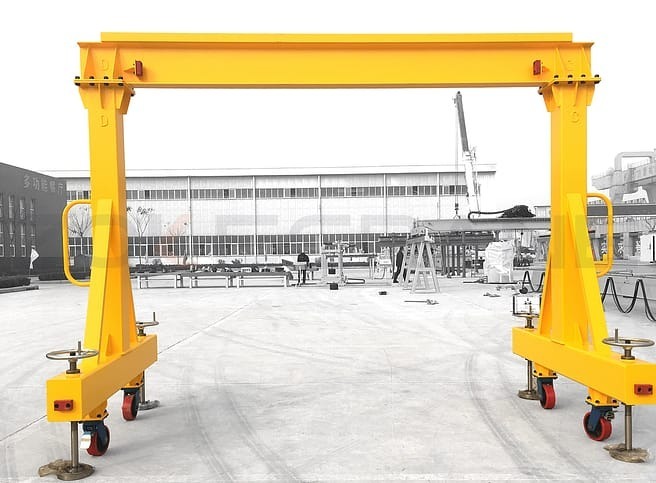
A portable gantry crane is a self-supporting lifting structure consisting of two vertical legs connected by a horizontal beam. The entire system is mounted on wheels or castors, allowing it to move freely across the ground without requiring rails or ceiling support.
Portability typically falls into two categories:
There are three main structural variants:
Steel Portable Gantry Crane
Designed for higher capacity applications, typically ranging from 5 to 20 tons. These are heavier, more stable, and suited for industrial environments.
Aluminium Gantry Crane
Lightweight and easy to assemble, usually in the 0.25 to 3 ton range. Ideal for applications where frequent setup and relocation are required.
Mobile Gantry Crane
Compact units with smaller spans and capacities (0.25–2 tons), designed primarily for confined spaces and light-duty tasks.
Each variant serves a distinct purpose. Choosing the right one depends entirely on the working environment and lifting requirements.
Manufacturing workshops deal with variable lifting requirements. One day, operators may need to lift a 2-ton component; the next, an 8-ton machine part. The lifting location also changes depending on workflow, machine maintenance, or production layout.
A fixed overhead crane provides coverage in a defined area but lacks flexibility. When work shifts across the floor, the crane cannot follow.
A portable gantry crane solves this limitation by moving with the work.
Workshop use is characterised by moderate to frequent lifting cycles. This makes duty classification critical. An A5 duty rating is generally appropriate, ensuring the crane can handle repeated use throughout the day without premature wear.
Floor conditions are typically stable — level concrete surfaces that support standard wheel configurations. However, wheel locking systems are essential. Any movement during a lift introduces safety risks.
For workshop environments handling up to 10 tons:
The choice of hoist is critical. While manual chain blocks may seem cost-effective, they are not suitable for frequent lifting. An electric wire rope hoist significantly improves efficiency, reduces operator fatigue, and ensures consistent lifting speed.
Electric chain hoists can be used for moderate loads with lower lift heights, but for heavy-duty workshop use, wire rope systems are more durable.
The most common issue is under specifying the hoist rather than the crane structure.
Buyers often select a crane with sufficient load capacity but pair it with a hoist rated for light-duty use. This mismatch leads to rapid wear, increased maintenance, and reduced operational lifespan.
Always ensure the hoist duty rating matches the actual usage conditions — not just the crane’s structural capacity.
Garages and small repair workshops operate under different constraints:
Typical lifting tasks include engines, transmissions, agricultural equipment, and small machinery components.
Installing a fixed crane system is often not feasible — either due to structural limitations or cost.
Here, the priority shifts away from maximum lifting capacity toward:
This is where aluminium gantry cranes become highly effective.
An aluminium system can typically be assembled by two people in under 30 minutes without specialised tools. When not in use, it can be dismantled and stored efficiently.
Height adjustability is also important, especially in facilities with ceilings below 4 metres.
For garage and light repair use:
This configuration provides sufficient lifting capability without introducing unnecessary weight or complexity.
The most frequent mistake is over specifying the crane.
Many buyers assume a steel crane is inherently better. In reality, a steel structure in this environment often becomes a liability:
Aluminium is not a compromise here — it is the correct engineering choice for the application.
Outdoor environments — such as construction sites, prefabrication yards, and temporary project locations — present unique challenges.
There is no fixed structure for mounting a crane, and lifting requirements change as the project progresses. Equipment must be adaptable and independent of the surroundings.
Outdoor use introduces several additional considerations:
Ground Conditions
Unlike indoor concrete floors, outdoor surfaces may include gravel, soil, or uneven terrain. This affects stability and load distribution.
Wheel Design
Larger wheel diameters (typically 400–600 mm) improve mobility and reduce ground pressure, preventing sinking or instability.
Weather Exposure
Wind, moisture, and temperature variations impact both safety and equipment durability. Wind, in particular, can affect stability during lifting operations.
Corrosion Resistance
Steel cranes must be properly treated to resist rust, especially in humid or coastal environments.
For outdoor applications up to 10 tons:
For remote sites without power access, a manual chain block is a practical and reliable alternative.
The most critical oversight in outdoor applications is ignoring ground bearing capacity.
A fully loaded gantry crane concentrates weight through four wheel contact points. On soft ground, this can lead to:
Using spreader plates under the wheels can significantly improve stability by distributing the load.
Each application prioritises different factors:
There is no universal solution. The correct configuration always depends on the working environment.
Before purchasing a portable gantry crane, confirm the following:
Certification
Ensure the crane meets relevant standards such as CE certification for compliance and safety.
Load Testing
Verify that the manufacturer conducts full load testing before delivery and provides documentation.
Hoist Compatibility
Confirm that the hoist matches the crane in capacity, duty class, and headroom requirements.
Spare Parts Availability
Check lead times for replacement components such as wire ropes and brake systems.
Assembly Documentation
Clear instructions and drawings are essential for safe and efficient setup on site.
A portable gantry crane is not a one-size-fits-all solution. Its effectiveness depends entirely on how well the configuration matches the application.
Choosing based on actual operating conditions — rather than maximum capacity or lowest price — ensures both safety and long-term value.