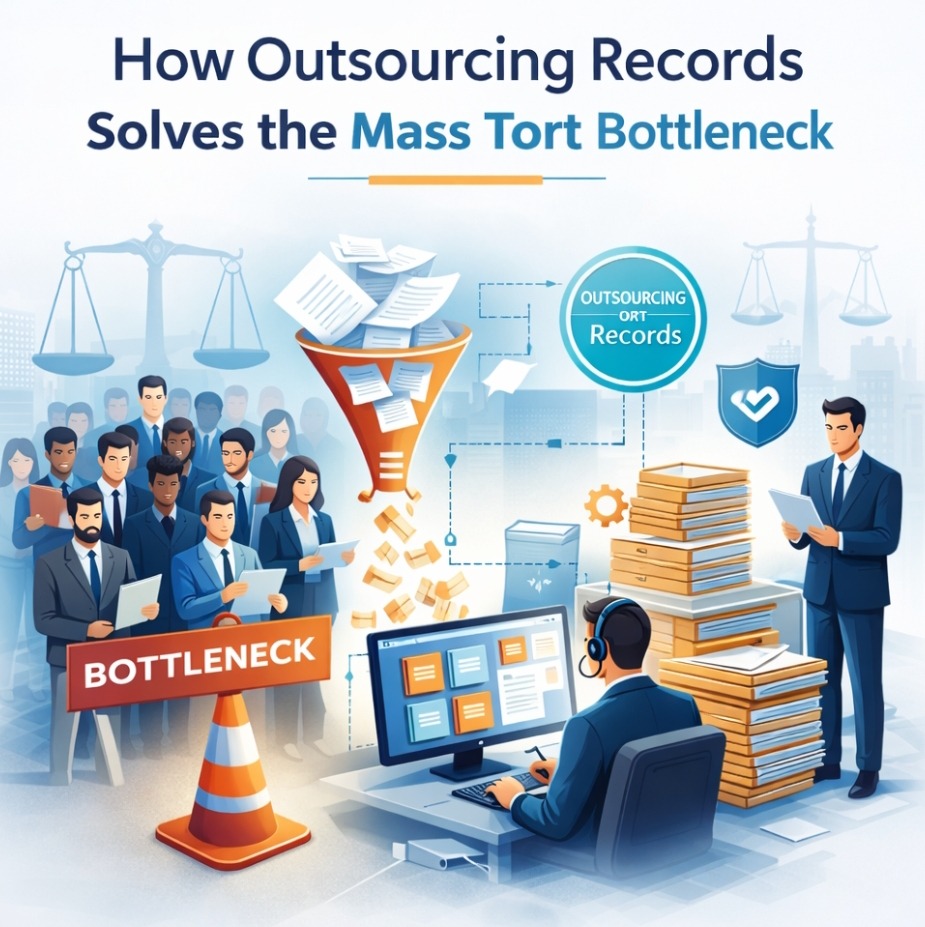
Multidistrict litigation is consuming the federal docket at an unprecedented rate. Managing these massive cases requires a level of operational efficiency that most traditional law firms simply do not have built into their current workflows. Multidistrict litigation (MDL) cases constituted roughly 65% of all civil cases pending in U.S. District Courts by July 2024.
As these massive dockets dominate the legal landscape, operations managers and firm partners are quickly realizing that manual record collection is no longer a sustainable practice. Asking your legal staff to chase down thousands of individual medical files leads directly to administrative burnout. It stalls your cases and frustrates your most talented team members.
Medical record retrieval is significantly more complex in mass torts compared to standard personal injury cases. A typical personal injury claim might involve three to five medical providers for a single plaintiff. A mass tort campaign often involves thousands of plaintiffs, each with their own complex web of hospitals, clinics, and specialists spanning several years.
This sheer volume of processing thousands of documents drains internal resources. Your paralegals and legal assistants end up spending their days on hold with unresponsive hospital records departments. They are forced to navigate dozens of different third-party release portals, each with its own specific authorization requirements and fee structures.
Delayed, incomplete, or incorrect records actively stall your case progress. When a medical file arrives missing key pathology reports or containing illegible physician notes, your team has to start the retrieval cycle all over again. These delays prevent your firm from building strong causation arguments, which ultimately weakens your position during settlement negotiations.
Using highly trained legal staff for administrative document chasing is a massive financial drain on your firm. Industry data shows that 77% of small to mid-sized law firms report spending too much time on administrative tasks instead of actually practicing law.
Outsourcing medical record retrieval for mass tort cases allows firms to officially minimize non-billable hours by transferring the entire retrieval lifecycle to a specialized team. You no longer have to worry about submitting HIPAA authorizations, following up on ignored requests, or fighting with facilities over excessive copy fees. A dedicated service provider handles the entire process from the initial request to the final delivery of organized digital files.
A specialized retrieval partner also enforces strict quality checks on every document received. They proactively verify patient ID matching, ensure the records cover the correct requested timeframes, and check for legibility. If a hospital sends a file with missing pages, the vendor automatically initiates the follow-up process to secure the complete record before it ever reaches your desk.
This external expertise actually helps your lawyers extract more value from your cases. Experienced retrieval teams know exactly how to track down easily overlooked costs that boost settlement values. They routinely identify and recover separate radiology billing, ER physician group notes, and outsourced pathology reports that in-house staff might miss.
Consider the stark difference in daily workflows when comparing an internal process to an external partnership:
Handling mass torts effectively requires moving away from one-off, manual requests. You need the ability to execute bulk processing via SFTP (Secure File Transfer Protocol). This technology allows your firm to securely send massive batches of plaintiff data and receive thousands of completed records in a single, encrypted transfer.
Modern law firms also require 100% online ordering, retrieval, and billing systems. You should never have to fax a request or wait for a CD to arrive in the mail. A centralized online portal gives your operations manager real-time visibility into the status of every single record request across your entire mass tort docket.
Seamless tech integration with major legal case management systems is another non-negotiable feature. When your retrieval partner integrates directly with platforms like Filevine, Assembly Neos, or Needles, it completely eliminates manual data entry. The requested records automatically populate into the correct plaintiff's digital file, notifying your team the moment they are ready for review.
Manual record retrieval is a severe bottleneck that actively limits a law firm's ability to scale its mass tort dockets. You cannot efficiently manage thousands of plaintiffs if your legal staff is constantly bogged down in administrative paperwork and provider follow-ups. The traditional in-house model is simply too slow and too expensive to support modern, high-volume litigation.
Adopting a specialized vendor directly eliminates this non-billable drain on your resources. It secures a reliable, transparent audit trail for your accounting team and radically accelerates your overall case timelines. When you automate the document collection process, your firm can build stronger cases faster.