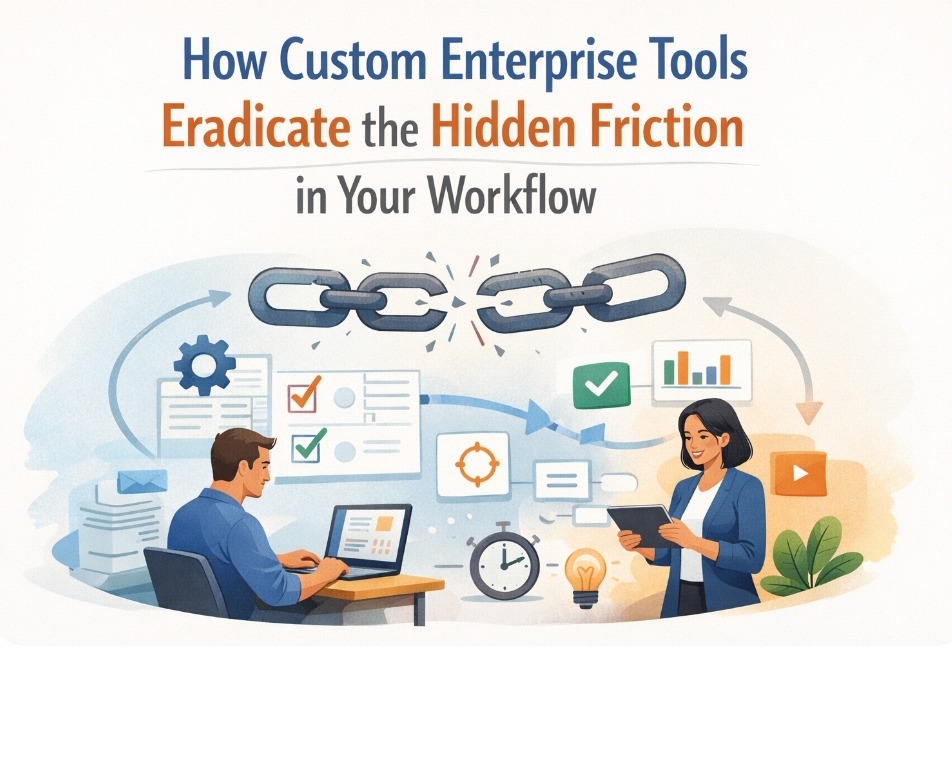
Operations leaders hear the exact same complaints from their teams every single day. Employees are deeply frustrated by clunky, disconnected systems that force them to invent manual workarounds just to finish their core tasks.
You likely see your staff using sprawling spreadsheets to patch the functional gaps between rigid software platforms. These manual patches slow down service delivery, invite human error, and create an exhausting environment for your best talent.
Accepting this software-induced friction as "just the way it is" is a direct threat to employee productivity and your company's bottom line. The longer you ignore the inefficiency of your tech stack, the more expensive your daily operations become.
Fortunately, you do not have to throw away your entire software ecosystem to fix the problem. There are highly scalable, custom solutions available to eliminate these operational bottlenecks without enduring the chaos of a full system teardown.
We must first define "hidden workflow friction" to understand exactly what it is costing your organization. It is the repetitive manual data entry, the sluggish system response times, and the daily process workarounds caused by rigid technology.
Friction happens when your team spends more energy managing the software than actually executing their strategic duties. It is the unseen tax on every single task your company completes.
The financial stakes of ignoring this friction are staggering. Recent industry analysis shows the cost of poor software quality in the U.S. has reached an estimated $2.41 trillion, encompassing operational glitches and legacy system problems.
Instead of forcing your team to adapt to rigid, out-of-the-box platforms, the most efficient organizations are taking an anti-rigid approach. By investing in custom enterprise software development, you can bridge the gap between technical execution and operational needs, building a tech stack that truly supports your business goals.
As an operations leader looking at your current overhead, you have to ask yourself a difficult question. How much of that lost revenue is leaking out of your own operations right now due to inefficient technology?
One of the most glaring symptoms of rigid software is the fragmented, chaotic ecosystem it leaves behind. Employees currently spend roughly 20% of their work week simply searching for internal information across disconnected departments.
That equates to nearly one full day per week wasted on a digital scavenger hunt. Instead of moving projects forward, your team is hunting through chat logs, emails, and legacy databases just to find a single client record.
This productivity drain is heavily compounded by the mental fatigue of constant context shifting. Research shows that knowledge workers switch between 10 apps up to 25 times per day, leading to missed deadlines and duplicated work.
When critical data is trapped in department-specific silos, executives cannot make informed, real-time decisions. These data silos cost organizations an average of $7.8 million annually, making seamless system integration an urgent financial priority.
The solution to this widespread operational friction is not necessarily tearing down your entire IT infrastructure. Ripping and replacing core systems is incredibly expensive, highly disruptive, and often introduces entirely new sets of problems.
Often, the smartest and most cost-effective path is to customize and carefully connect your existing systems so they function seamlessly together. Custom enterprise tools target and permanently remove the friction of manual workarounds by automating repetitive, low-value tasks.
When you remove the busywork from their daily plates, your team has the bandwidth to focus on strategic initiatives that actually drive growth. Furthermore, a customized software ecosystem dramatically increases overall employee user adoption.
People instinctively resist software that requires them to perform extra, illogical steps. When your technology suddenly makes their jobs easier rather than harder, employees naturally gravitate toward using the tools exactly as intended.
The fastest way to eliminate operational friction is to get your separate software platforms talking to one another. Secure APIs act as digital translators, instantly connecting disparate systems like your ERP, CRM, HR, and Finance platforms.
Instead of an employee manually exporting a spreadsheet from the CRM just to upload it into the billing system, an API handles that data transfer securely in the background. Connecting the dots between these isolated systems permanently breaks down operational silos.
This deep connectivity provides operations leaders with accurate, real-time data dashboards that reflect the true state of the business at any given second.
Ultimately, API integration creates a smooth-running centralized command center for your entire enterprise. It entirely eradicates the friction of manual data transfer and ensures every department is working from the same single source of truth.
Even the most robust, expensive enterprise resource planning systems can feel incredibly rigid right out of the box. However, by building custom modules, you can configure these otherwise inflexible platforms to match your exact operational needs.
Custom modules act as tailored extensions that wrap around your core ERP engine. This requires embracing a deeply pragmatic technical philosophy: software should adapt to the way your company actually works, rather than forcing you to change how you do business.
When you implement workflows tailored to your specific industry and team habits, the operational benefits are immediate and measurable. You will experience faster employee onboarding, significantly fewer manual data errors, and a much more agile response to sudden market changes.
Modernizing a legacy tech stack is not just a technical challenge; it is a fundamental business strategy. The "business-first" approach involves deeply analyzing how a company operates on a daily basis before a developer writes a single line of code.
You cannot fix a workflow problem if you do not thoroughly understand the human element behind it. Successfully revitalizing legacy systems requires a partner who understands operational reality, not just technical development and coding languages.
A strong modernization partner needs to know why your warehouse team struggles with a specific inventory screen, or why your finance department relies on external spreadsheets to reconcile accounts. They must shadow your users to identify the exact source of the friction.
Modernizing outdated applications through this highly practical lens does much more than just fix software bugs. It improves overall system performance, strengthens enterprise security protocols, and directly fuels business growth by removing the roadblocks holding your team back.
These strategic investments bridge the gap between disjointed platforms, eradicate manual data entry, and establish a unified command center for your data. By shaping the technology to fit your specific needs, you eliminate the daily frustrations that slow down your workforce.
Operations leaders must shift their mindset regarding their technology stack. You need to stop managing frustrating tech and start investing in strategic tools that actively empower your workforce. When your software finally aligns with your operational reality, your business is perfectly positioned to scale without limits.