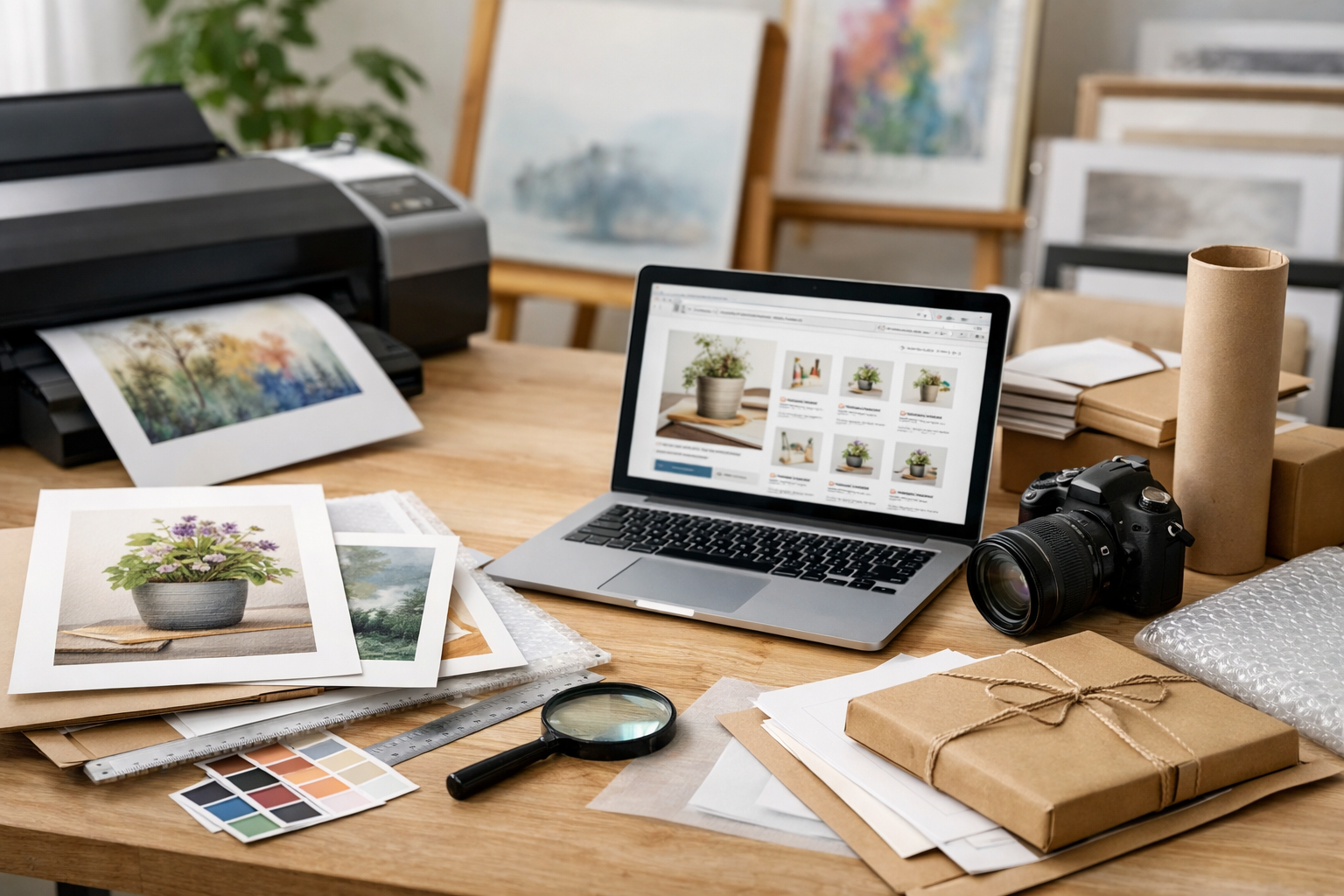
Selling prints online sounds simple until the first real questions hit, especially when you are trying to figure out how to sell art prints online successfully. What should go on the product page? Which platform makes sense? How much should the print cost? How do buyers decide fast, and why do some shops get clicks while others get ignored?
That pressure feels familiar to founders, solo operators, and first-time sellers. People want clear facts, fair pricing, strong photos, and proof that the seller can deliver.
If you’ve ever searched how to make money as a college student, art prints can be one low-risk answer, especially when print on demand lets beginners start without a pile of inventory.
Prints give artists a way to sell the same work more than once. That makes them easier to grow than original art alone, and it opens the door to open edition prints, limited edition prints, digital art prints, and physical art prints from the same core image.
Beginners are often pointed toward prints, digital products, and direct sales through online stores and marketplaces because they offer a practical way to start small and scale over time.
It’s still not instant money. A real art print business needs good files, smart pricing, clean listings, and steady traffic from search, email, or social media.
Original art is the one-and-only piece. Reproductions, also called art reproductions, let you sell copies as posters, canvas prints, archival prints, or fine art paper prints. If you want a lower-priced entry product, reproductions usually make more sense.
Open edition prints have no fixed cap. Limited edition prints have a set number, and artists often add signed prints or numbered prints to raise perceived value.
Open edition prints in different sizes, frames, and materials are common for beginners and mid-market buyers because they are easier to produce and easier to sell at scale.
Digital downloads are printable wall art files that the buyer gets right away. Physical prints are mailed items, framed or unframed.
Digital files are the lowest-cost start, but physical art prints usually feel more premium and can support stronger collector pricing.
Good print sales start with good files. Artists need strong scans or photos, while most print providers recommend PNG or JPEG files, sRGB color, and 300 DPI for high-quality paper prints.
If you scan artwork, keep file dimensions large enough for the print size you want to sell.
If you photograph artwork, use even light, square framing, and color checks so the print matches the original as closely as possible.
High-quality photos and careful color correction matter because poor presentation can damage trust before a shopper even reads the description.
RGB and CMYK matter because screens and printers read color in different ways. Some print systems are built for sRGB files and then convert them for print, so test prints are still smart before launch.
Paper quality matters too. Fine art paper prints are often sold as giclée reproductions on archival-quality paper, while photo paper gives a smoother look and satin finish.
That’s a useful reminder for any beginner: paper, finish, and print size shape how premium the work feels.
Etsy is strong for beginners because the traffic is already there. Search ranking on Etsy is influenced by titles, tags, categories, attributes, conversion rate, and customer service.
Shopify is better when the goal is control. It gives artists more room to build a long-term brand, manage cleaner URL slugs, create internal links, and publish blog content later.
Third-party marketplaces can work when you want discovery fast. Some platforms let artists upload work, set prices, and leave printing, framing, packaging, shipping, and payments to the marketplace.
POD is the easiest on-ramp. Services like Printful, Printify, and Gelato make it possible to run an inventory-free model. That lowers risk and makes no minimum order quantity, or no MOQ, easier to find across providers.
Self-fulfillment gives more control over paper quality, packaging, inserts, and branding. It can also improve profit margin once volume grows, but it adds storage, order processing, shipping speed pressure, and damage risk.
A good print provider should be checked on:
Ordering samples before launch is one of the smartest steps a beginner can take.
Start with real costs. That includes production costs, shipping costs, sleeves or backing boards, platform fees, transaction fees, and the time spent on customer service.
It also helps to offer different price points and build packing costs into shipping where needed.
Then price by size, edition, and position. A small unframed open edition print can be the affordable print that brings in new buyers. A bigger signed print on fine art paper can sit at the premium end.
That mix helps both first-time shoppers and collectors.
One mistake shows up all the time. Artists copy a competitor’s price without checking their own margin.
If the numbers break the minute a return, reprint, or damaged package shows up, the price was wrong from the start.
Titles should say what the item is before they say what it means. Buyer-friendly, search-ready titles matter because they help both search engines and shoppers understand the product quickly.
A strong product title might look like this: Botanical Art Print, Neutral Wall Art, 11x14 Giclée Print, Unframed Bedroom Wall Art.
That covers product type, style, size, and use case in plain language.
Descriptions should open with the key facts, and short paragraphs work better for buyers scanning on mobile.
A good first line might be:
Archival fine art print on textured paper, sold unframed in 8x10, 11x14, and 16x20 sizes.
Then add paper, frame status, shipping info, and whether it’s a digital download or physical item.
Image alt text should describe what’s in the photo. This helps blind and low-vision buyers understand listing images, and it improves overall store quality.
On your own website, place keywords in the meta title, meta description, H1, body copy, and internal links.
Pinterest works well for long-tail keywords because people search with intent. Blog posts on your own site can also bring search traffic, especially when they match terms like best place to sell art prints online, how to sell wall art online, or how to price limited edition prints.
Instagram and TikTok still matter, but they work best when they show process. Studio clips, packing videos, paper comparisons, and before-and-after framing shots give buyers a reason to trust the shop.
Build an email list early. That’s where repeat buyers, collector relationships, and new-release drops start to pay off.
Track traffic sources, Google Analytics, and conversion rate so the next listing gets sharper, not just prettier.
Image theft is real. Any public image online carries risk, so it helps to use photos of the actual print in a room scene instead of posting large, clean source files.
Heavy watermarks can also hurt presentation, so protection needs to be balanced with a clean buyer experience.
Trust builders are simple:
Prints should also be packed with a hard backing like chipboard or foam core to prevent bending.
Choose one product path. Start with either open edition POD prints or digital downloads, then pick Etsy or Shopify.
Prep files and order samples. Check 300 DPI, color accuracy, print size, and paper quality.
Upload 8 to 12 listings. Write searchable product titles, short product descriptions, collection names, alt text, and mobile-friendly photos.
Promote and track. Post on Pinterest, send one newsletter, watch analytics, and fix the listings that get views but not sales.sell art prints online
Start small. Test what sells. Keep the files sharp, the pricing honest, and the product page clear. That’s how artists starting out selling prints and building a following avoid burning cash or guessing in the dark.
Once prints work, the brand can grow into other lines like cards, calendars, or custom t-shirts. But the base stays the same: strong art, strong trust, and a store that makes buying feel easy.