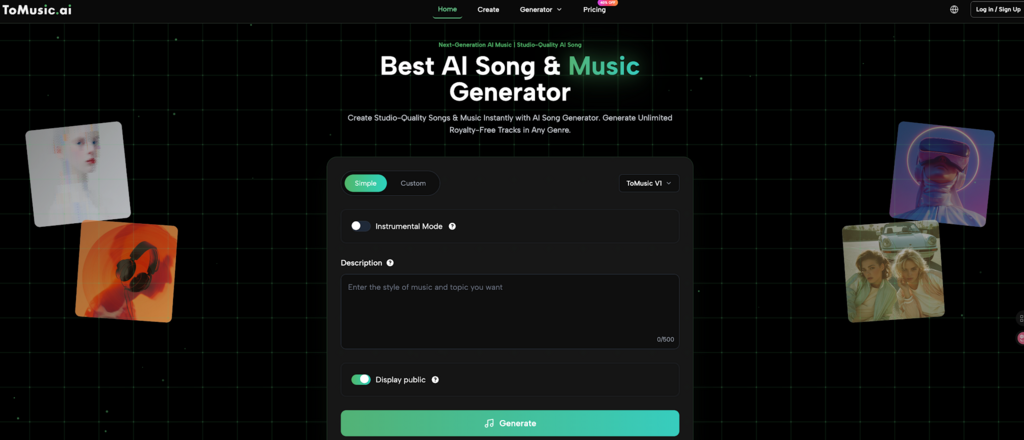
Finding the “right” background track for a video is rarely about any music—it’s about music that feels exactly like the scene. Stock libraries often get you 80% of the way there, then you lose time scrolling because the mood is slightly off, the tempo doesn’t match your edits, or the track builds at the wrong moment. A faster, more reliable approach is to generate music that matches your content on demand. That’s why creators use tomusic ai music generator to produce royalty-friendly tracks that fit specific video vibes in minutes—without auditioning dozens of options.
Even good music libraries can miss the mark because they’re built on broad tags and fixed structures:
When music is “close but not perfect,” creators waste the most time: constant swapping, re-cutting, and re-exporting.
Before you generate anything, define what the music needs to do for your video. This makes your results more consistent and helps you choose faster.
1. Identify the music’s job
Pick one:
2. Define 4 parameters (the “fit” checklist)
You only need four:
3. Decide where the “peak” should land
This is the biggest mismatch with stock trucks. For example:
The fastest way to match a video’s vibe is to avoid starting from a blank prompt every time. Instead of guessing the perfect wording, a theme-based approach gets you close immediately.
ToMusic AI Music Generator helps here by offering many different themed generators, so you can pick the one that matches your content type and let the generator do heavy lifting. This saves time in two ways:
You don’t need to audition dozens of tracks—you start in the right “lane.”
You don’t need to write complex prompts—the theme already anchors the musical direction.
Examples of theme directions creators commonly need include:
The result: you get music that feels purpose-built for your scene—without spending your creative energy on searching.
Here’s a repeatable workflow you can use for any video format.
Match the theme to the edit:
This single choice eliminates most “wrong vibe” outputs.
Use a simple sentence that includes scene + mood + tempo. Then add two constraints that make the track easier to edit.
Example format (use this every time):
Example sentence: “Background music for a tech review with a clean, confident mood, medium tempo, minimal synth texture; loop-friendly and clean ending; no vocals.”
Don’t generate 10 random versions. Generate three and change only one knob each time:
Pick the one that:
1. Voiceover tutorials
Goal: music should be present but invisible.
Best direction: minimal/relaxing/mood, no vocals, low percussion.
2. Travel B-roll
Goal: wide, cinematic feel without overwhelming the visuals.
Best direction: dreamy/weather/story-style, gentle build, clean ending.
3. Shorts montage
Goal: energy in the first seconds and a steady groove.
Best direction: motion/upbeat/slowed-reverb depending on style, minimal melody.
4. Study / long background loops
Goal: stable, non-distracting, long-form friendly.
Best direction: calming classroom/sleep, minimal variation, smooth texture.
When music fits perfectly, your video instantly feels more professional—but finding that perfect track in a stock library can drain time and energy. A theme-first workflow solves this: choose a generator that matches your content type, describe the scene in one sentence, add loop + clean ending constraints, then generate a few controlled variations.
If you want to stop searching and start matching music to your edits in minutes, try tomusic ai music generator and build your own repeatable “video vibe → music” workflow.