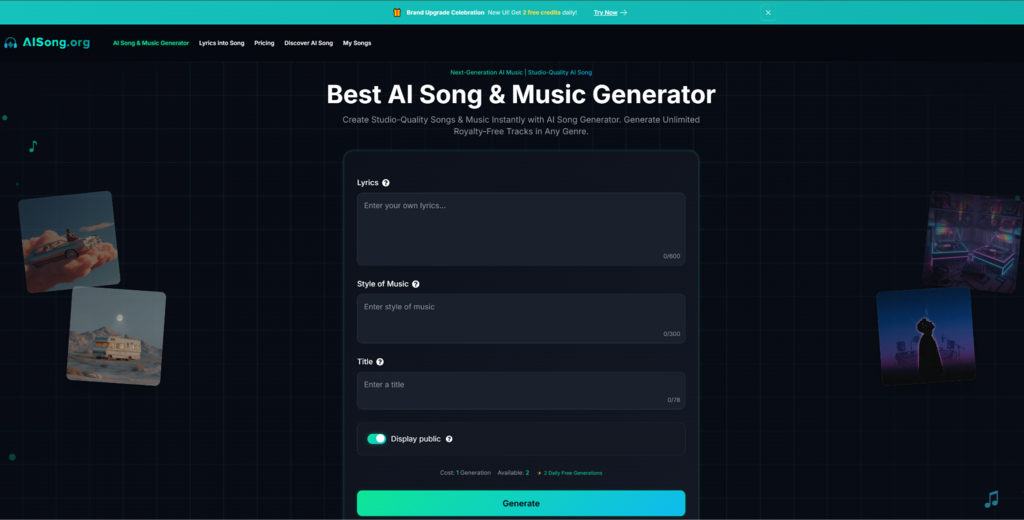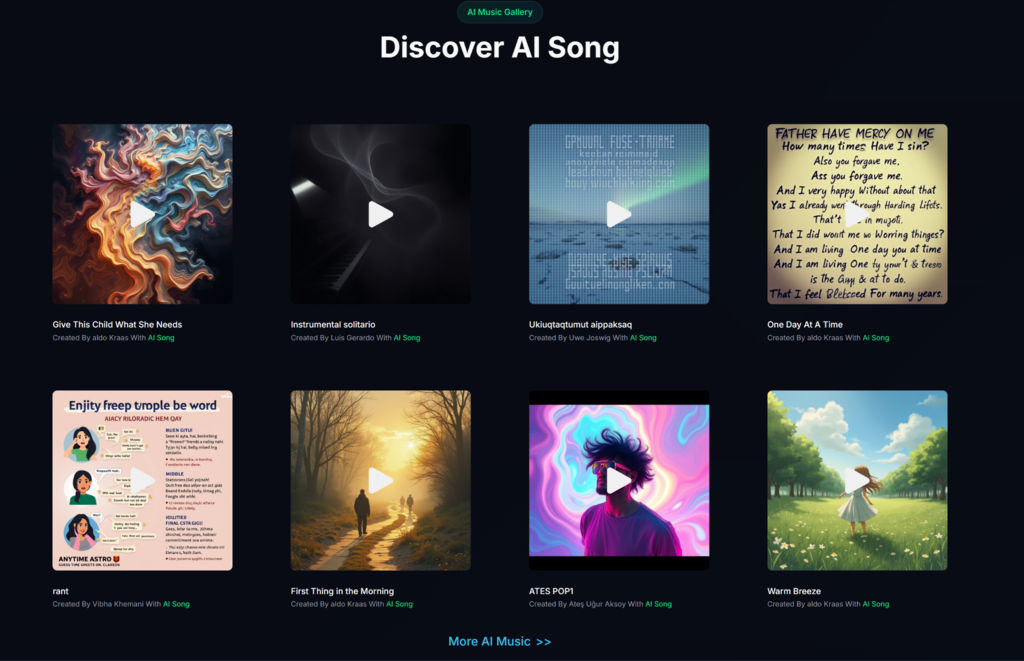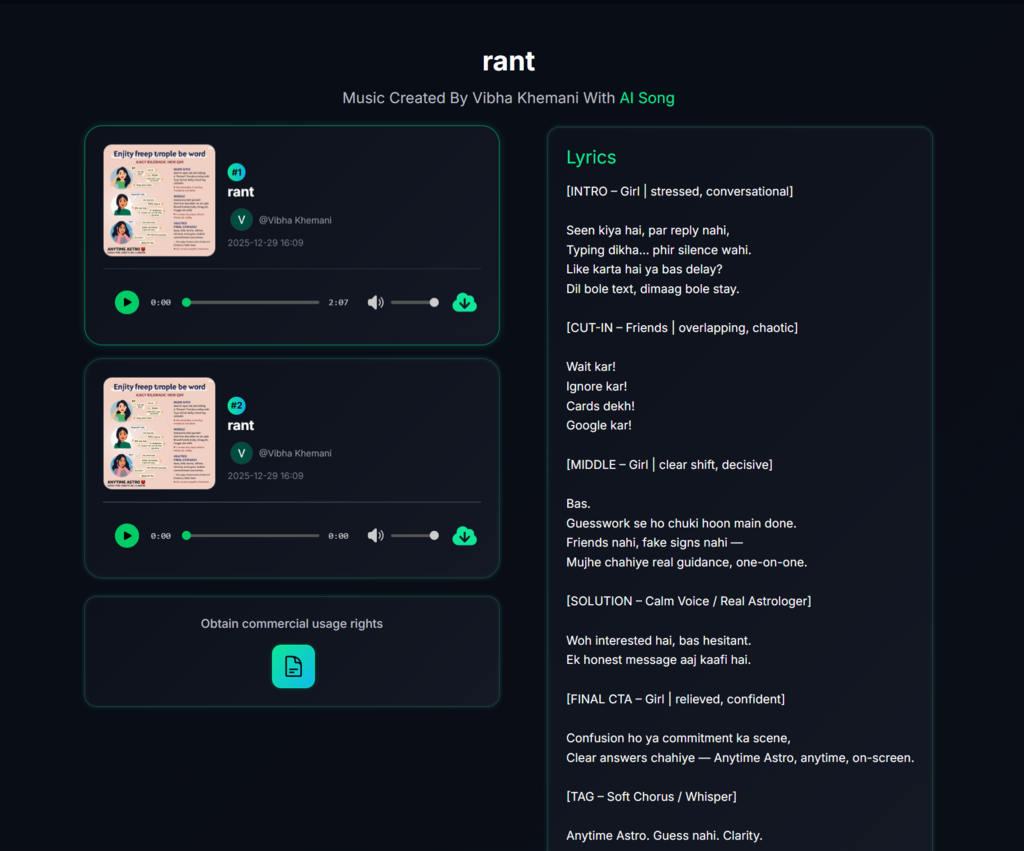
I used to think the hardest part of making music was the music. Turns out, the hardest part is often the first usable draft—the moment when an idea becomes something you can listen to, critique, and improve. That’s why I started testing an AI Song Generator as a practical shortcut to “audible proof.” Not to replace musicianship, but to reduce the dead time between I can imagine it and I can hear it.
What surprised me most was how quickly it turned vague intent into something concrete. I would write a short brief—mood, tempo, instrumentation, structure—and within minutes I had a draft that made the next decision obvious. Sometimes that decision was “this is promising.” Other times it was “the groove is wrong—change direction.” Either way, I stopped guessing.
The goal was not to generate a perfect, release-ready track. The goal was to answer a set of stubborn questions that normally take hours to resolve:
The most useful mindset shift for me was this: treat the generator like a prototype lab.
In a prototype lab, you do not expect the first version to be final. You expect it to be informative. You run small experiments, compare outcomes, and iterate with intent.
That also changes how you write prompts. Instead of poetry, you write constraints. You specify what matters and what should not happen.
I ended up using a three-stage workflow that felt repeatable.
I wrote a “one-screen brief” with a few anchors:
I would generate 3–5 drafts, but with discipline:
I would pick one draft and treat it as the direction. Only then would I refine lyrics, structure, or instrumentation—because now I had evidence.
I noticed I got better outcomes when I chose the workflow based on my input type.
Use description-to-music generation when you need:
Use lyrics-to-song generation when you want to test:
When my lyrics had uneven line lengths, the vocal phrasing sometimes felt cramped. Tightening a few lines often fixed more than changing the genre.
This is not a “winner takes all” tool. It fits best when speed and exploration matter more than microscopic control.
Instead of rewriting the entire prompt, I changed one knob:
This made progress feel logical rather than random.
Adding an avoid list reduced unpleasant surprises:
A tool feels more trustworthy when you can name its boundaries.
That variability is useful for brainstorming, but it means you should expect selection, not perfection.
In my testing, 2–6 drafts often produced one that felt directionally correct. Treating early outputs as sketches kept expectations realistic.
Instrumentals stabilized faster. With vocals, intelligibility and phrasing can fluctuate—especially when lyrics have complex meter.
If your plan is distribution or monetization, read the platform terms and plan entitlements carefully. “Royalty-free” language can coexist with detailed conditions, so it’s wise to confirm what applies to your use case.
If you want a broader view of generative AI’s progress in creative domains, neutral reporting like Stanford’s AI Index is a useful anchor. It does not endorse a specific product, but it provides context on capabilities and adoption trends.
I expected a shortcut to “music.” What I actually got was a shortcut to “clarity.”
When a draft exists, you stop debating adjectives and start making decisions. You can say:
That is the real value of an AI song generator when you use it as a drafting partner. It turns intention into audio quickly enough that your taste and judgment can do their job.
Results will vary with prompt clarity, genre complexity, and iteration count. In my own tests, disciplined iteration—one change at a time—produced more predictable improvements than regenerating endlessly without revising the brief.