In photography and cinema, the angle of the camera is never accidental. It is emotional language.
A low angle makes a hero look powerful. A high angle makes a subject look vulnerable. A direct gaze creates intimacy, while a profile view suggests mystery.
But for creators working with AI-generated imagery or standard stock photography, this language has effectively been "lost in translation." You often get a beautiful image, but the emotional tone is slightly off because the camera is placed arbitrarily.
You try to fix it. You rewrite your prompt. You plead with the algorithm. But the result is usually frustrating: the AI generates a new image with the right angle but the wrong feeling. The magic is gone.
This disconnect is exactly what I wanted to investigate when I began testing 3D Camera Control AI.
The promise was not just about technical manipulation; it was about reclaiming that lost emotional control.
I conducted a test using a generated portrait of a weathered sailor. In the original image, he was facing the camera directly—it felt confrontational, almost aggressive.
My goal was to soften the image, to make him look "in thought" rather than "in combat."
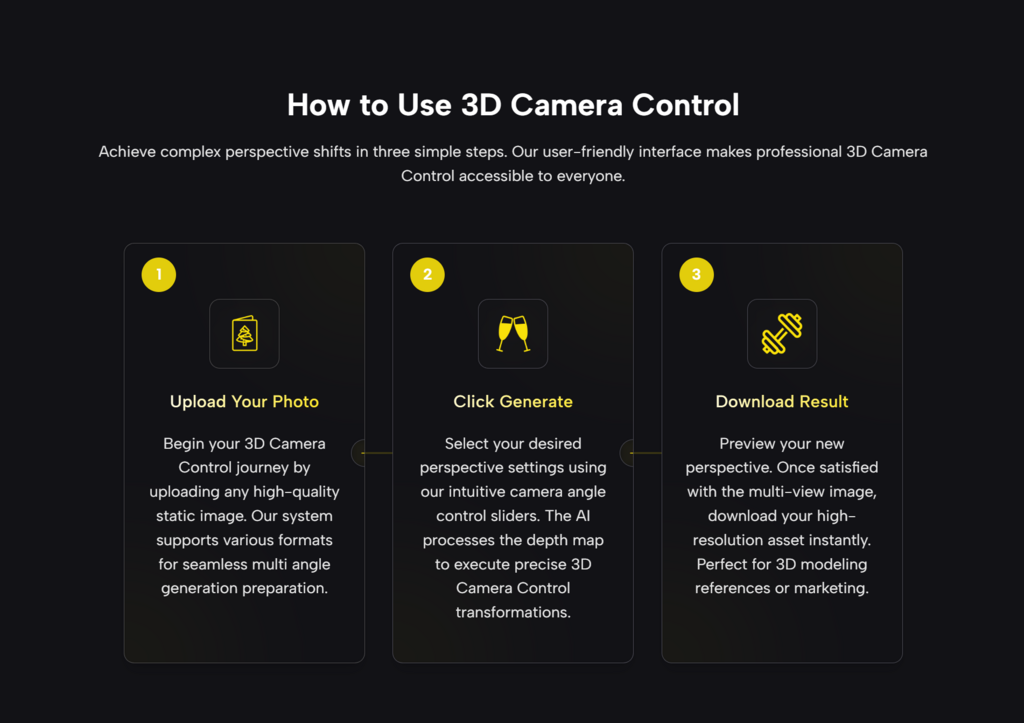
Using the tool’s interface, I adjusted the Y-Axis (Yaw) to rotate his head about 25 degrees to the right. The transformation was immediate.
The AI didn't just skew the image; it seemed to understand the volumetric depth of his face. The nose obscured the far cheek appropriately. The lighting shifted across his forehead.
Suddenly, the narrative of the image changed. He was no longer staring at me; he was looking toward the horizon. The mood shifted from "confrontation" to "contemplation" in seconds.
From a technical standpoint, what I observed is a sophisticated form of Depth-Aware Inpainting.
Unlike traditional filters that flatten an image, this AI appears to:
It feels less like editing a photo and more like directing a digital actor.
To illustrate why this tool is a necessary addition to a professional workflow, we must compare it to the standard method of "prompt engineering."
This technology opens up specific doors for narrative designers and marketers that were previously welded shut.
Marketers know that eye contact converts. But too much eye contact can be unnerving.
With 3D Camera Control, I realized I could generate three versions of a hero image for a landing page:
This allows for precise A/B testing without the cost of a reshoot.
For comic creators or storyboard artists, the biggest pain point is scene consistency.
If your character is walking through a door, you need to see them from the back or side. This tool allows you to take your character design and literally "turn" them to walk into the scene, maintaining their costume details far better than trying to draw them from scratch.
While my experience was largely positive, it is important to treat this technology as an assistant, not a miracle worker.
There is a "Zone of Credibility." In my tests, I found that rotating a subject up to 30 or 40 degrees yielded professional, convincing results.
However, when I pushed the sliders to the extreme (trying to see the back of a head from a front-facing photo), the illusion broke.
It works best when used to refine a composition, not to completely reinvent it. Think of it as a tool for subtle persuasion, not radical transformation.
For too long, digital creators have been at the mercy of the "random seed." We accepted the angles we were given.
3D Camera Control represents a shift back to agency. It acknowledges that the subject of an image is just the beginning; the perspective is where the story is told.
By allowing us to manipulate the X, Y, and Z axes of a static moment, this technology gives us the freedom to stop compromising. You no longer have to settle for an image that is "good enough." You can twist it, turn it, and align it until it matches the vision in your head perfectly.