Most collectors don't realize they're slowly destroying their most prized possessions. Walking into a living room one afternoon to discover a signed baseball with a faded autograph is a harsh wake-up call. The signature that had been bold and clear six months earlier looks ghostly and barely visible. This scenario plays out in homes across the country, and it raises critical questions that every serious collector should be asking about UV protection.
Ultraviolet radiation doesn't announce itself. There's no warning sign when collectibles are being damaged. The sun streaming through windows looks harmless enough, but those UV rays work around the clock to break down the molecular structure of everything they touch. Fabrics fade. Inks deteriorate. Plastics yellow and become brittle. Papers turn brown and fragile.
The worst part is how gradual the process happens. Collections don't get ruined overnight. It's a slow fade that occurs over months and years. By the time the damage becomes noticeable, it's often irreversible. That signed basketball jersey purchased for $800 might only be worth $200 now because the signature has faded to almost nothing.
Appraisers regularly see collections lose tens of thousands in value purely because of UV exposure. One documented case involved a complete set of vintage Star Wars figures, still in original packaging, displayed on shelves near a south-facing window. After five years, the packaging had yellowed so badly that the set lost about 40% of its value. The figures themselves were fine, but in the collectibles world, packaging condition is everything.
On a molecular level, UV radiation has enough energy to break chemical bonds. When it hits memorabilia, it literally breaks apart the molecules that create colors, hold materials together, and form the structure of inks and dyes.
For autographs, UV rays break down the pigments in ink. Different inks fade at different rates, but all of them are vulnerable. That black Sharpie signature might turn brown, then gray, then barely visible. Blue ink often fades even faster.
Fabrics are especially vulnerable because dyes are designed to bond with fibers, but UV radiation disrupts that bond. Red dyes typically fade first, which is why vintage jerseys often show red that has turned pink or orange. Navy blues become lighter blues. Even supposedly colorfast materials will eventually succumb to enough UV exposure.
Photographs and trading cards face similar problems. The chemicals in photo paper and printing inks degrade under UV light. Old photographs that have turned yellow or lost their contrast show classic UV damage. Modern trading cards use better materials than vintage ones, but they're still susceptible over time.
Walk into any home with a sports memorabilia collection and standard frames or cases bought from craft stores or big box retailers are everywhere. These look nice, but most offer zero UV protection. Regular glass blocks virtually no UV rays. Standard acrylic isn't much better. Collections displayed this way might as well be sitting outdoors.
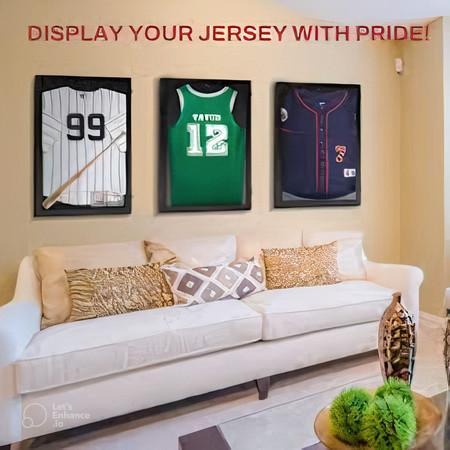
This mistake happens constantly with jersey displays. A nice-looking case keeps dust off and looks professional mounted on a wall. What many collectors don't realize is that without UV protection, the case offers no defense against the real threat.
Some collectors think that keeping items away from direct sunlight is enough. It helps, but it's not sufficient. UV rays bounce off walls, floors, and ceilings. Even artificial lighting produces UV radiation, especially fluorescent bulbs. Unless collections are kept in dark closets, they're being exposed to UV radiation constantly.
Professional museum-grade UV protection blocks at least 98% of harmful UV rays. This isn't just marketing language, it's a measurable specification. Quality display cases use specially treated acrylic or glass that filters out UV radiation while still allowing visible light through so collections can actually be seen and enjoyed.
The difference between UV-protective materials and regular glass or acrylic is significant. Regular glass blocks about 45% of UV rays. That sounds decent until the realization hits that 55% is still getting through to damage collectibles. UV-protective acrylic or glass blocks 98-99%, meaning only 1-2% of harmful radiation reaches items.
This level of protection extends the life of collectibles dramatically. An autograph that might fade noticeably in two years behind regular glass could remain vibrant for decades behind proper UV protection. The difference is between watching an investment deteriorate and actually preserving it for future generations.
The calculation around display case investment is straightforward. Consider a signed jersey worth $1,000. It can be displayed in a basic case for $150 or a UV-protective case for $300. The price difference is $150.
If UV damage reduces the jersey's value by just 30% over five years, that's $300 in lost value to save $150 on the case. That's terrible math. And 30% is actually conservative. Items with faded autographs or discolored fabrics often lose 50-70% of their value.
When factoring in the actual cost of replacement or restoration, spending more upfront on proper protection becomes an obvious choice. Professional conservators charge hundreds or thousands of dollars to restore damaged memorabilia, and often the damage can't be fully reversed.
Companies like Pennzoni Display have built their reputation on providing museum-quality protection because serious collectors understand this math. When protecting a memorabilia jersey worth hundreds or thousands of dollars, the jersey display case shouldn't be an afterthought or a budget item.
While UV protection is critical, it's not the only consideration for proper display cases. The best cases also provide protection against dust, humidity, handling, and physical damage. They're sealed well enough to keep environmental contaminants out while allowing memorabilia to be visible and appreciated.
Temperature stability matters too. Cases that allow significant temperature fluctuations can cause condensation, warping, or brittleness. Quality cases are designed with materials that don't trap heat or create temperature gradients that could damage contents.
The mounting system inside the case is equally important. Memorabilia shouldn't be pinned, taped, or attached with anything that could cause damage. Professional cases use acid-free backing materials and non-invasive mounting techniques that hold items securely without degrading them over time.
When evaluating display cases, ask about UV protection specifications. Don't accept vague claims like "UV resistant" or "reduces UV exposure." Ask for specific numbers. What percentage of UV rays does it block? Is it certified museum-grade?
Check the quality of construction. Look at how the case seals, what materials are used for backing, and how items are mounted. A case with excellent UV protection but poor mounting systems will still damage collections over time.
Consider the long-term value of what needs protection. For items worth $50, basic protection might be adequate. But for anything truly valuable or irreplaceable, cutting corners on the display case is penny-wise and pound-foolish.
Think about where the case will be displayed. Items in rooms with lots of natural light need the absolute best UV protection. Even items in lower-light areas benefit from UV protection because of ambient light and artificial lighting sources.
Every day without proper UV protection means more damage. The deterioration might not be visible today or next week, but it's happening. Each hour of exposure breaks down more molecules, fades more color, and reduces the value of collectibles.
Consider what happens over a decade. A $2,000 signed guitar displayed in a non-UV protective case near a window could lose half its value or more. That's $1,000 gone, money that could never be recovered. The signature fades until authentication becomes difficult. The finish loses its luster. What was once a prized possession becomes a cautionary tale.
Now multiply that across an entire collection. Someone with 20 valuable pieces losing 40% of their value over ten years isn't just losing money. They're losing the legacy they intended to pass down or the retirement fund they were building through collecting.
Smart collectors view proper display cases as part of their investment strategy, not as an expense. The goal isn't just to own memorabilia but to maintain or increase its value over time. UV protection is fundamental to that strategy.
Museums understand this principle. They spend millions ensuring their collections remain pristine for centuries. Home collectors don't need museum budgets, but they do need museum-quality thinking. The same principles that preserve artifacts in the Smithsonian apply to signed jerseys and vintage cards in private collections.
The memorabilia market has grown substantially, with rare items selling for record prices at auction. But condition is everything. Two identical signed items can have vastly different values based solely on preservation quality. The one kept in proper UV-protective display commands premium prices. The one that faded in a standard frame sells at a discount or doesn't sell at all.
The best time to invest in proper UV protection was when collections first started. The second best time is now. Every additional day without protection causes more irreversible damage.
Start by assessing current display situations. Are valuable items near windows? Are they in cases with actual UV protection or just standard frames? What's the lighting situation in display areas? These questions reveal where problems exist.
For new displays, make UV protection non-negotiable. It should be the first specification checked, not an optional feature. Ask vendors for documentation of UV protection levels. Reputable companies provide clear specifications and testing data.
For existing collections in inadequate cases, prioritize the most valuable or irreplaceable items for upgrade first. Even moving pieces to different locations away from direct light helps while proper display solutions are being arranged.
Collections represent more than just money. They represent memories, passion, and often years of hunting down specific items. Those signed jerseys, autographed photos, and rare cards deserve protection that matches their importance.
UV protection isn't optional for anyone who cares about preservation. It's the fundamental first step in ensuring collectibles remain in excellent condition for decades. The difference between a collection that maintains its value and one that deteriorates comes down to decisions made today about display and protection.
Learning about UV damage shouldn't come from watching a prized possession fade away. Smart collectors protect their investments from the start. When items eventually get passed on to the next generation or sold to other collectors, proper preservation pays dividends. Making the right choice about display protection today ensures collections remain valuable and beautiful for years to come.