Public health rarely draws attention when things are working as expected. Most people assume an ambulance will arrive when it is called, that a hospital bed will be available when it is needed, and that the air inside a home or school will feel safe to breathe.
It’s only when those systems start to buckle under pressure that people realize how much they depend on them. For Scott Bookman, Colorado public health leader, moments like that have been familiar over the past two decades.
Hospitals have reached capacity during outbreaks. Emergency rooms have operated with fewer staff than necessary. Smoke from wildfires has moved indoors and lingered there. During the COVID-19 pandemic, all of those strains intensified at the same time.
While those crises often made headlines, the work to manage them usually didn’t. Plans were adjusted, resources were shifted, and decisions were made quickly, often with incomplete information.
For more than 20 years, Bookman has worked in emergency medical services, hospital leadership, and statewide public health response, often when systems were stretched thin. In every role, his priority has been keeping those systems running when conditions were least forgiving, ensuring communities were never left without care.
Learning From the Front Lines
Bookman began his career at Denver Health and Hospital Authority, where he responded to medical emergencies as a paramedic. He later served as an educator and street supervisor within the organization.
Eventually, he moved into leadership positions within Denver Health EMS, first as a Captain overseeing scheduling and special event operations. From there, he spent seven years as Chief Paramedic, responsible for the city’s 911 emergency medical system. In that role, he oversaw EMS education, field operations, critical care transport, and medical operations at Denver International Airport.
During that time, Denver Health EMS began addressing the growing risks posed by distracted drivers to emergency responders. Bookman, then Chief Paramedic, acknowledged that while most drivers don’t intentionally block ambulances, it was enough of a problem to warrant change.
In 2012, the agency started testing low-frequency subwoofer sirens on a dozen ambulances. The system emitted sound that could be felt inside vehicles, designed to reach distracted drivers who might not hear traditional sirens.
Bookman described the sound as highly effective. After 18 months of testing, Denver Health made the sirens standard equipment on new ambulances.
Around the same time, Denver Health was applying Lean management practices across the organization. Bookman was involved as part of the EMS leadership team, and the effort focused on reducing delays and inefficiencies without cutting services.
Within EMS, the changes improved dispatch flow, staffing, scheduling, and vehicle readiness. In the first year alone, overtime costs dropped by nearly $400,000 without affecting response times. As the work continued, the division generated more than $5 million in savings and additional revenue.
Putting Preparation to the Test
While system improvements were underway, Bookman continued responding to large-scale emergencies across Denver, including a commercial airline crash at Denver International Airport, where he served as incident commander.
In 2013, Denver’s emergency medical response system still struggled to meet National Fire Protection Association response-time standards. Advanced life support arrived within target times 77 percent of the time, while basic life support met the standard about 83 percent of the time.
Bookman acknowledged how difficult those benchmarks were to meet and emphasized improving patient outcomes rather than focusing on response times alone.
Those constraints were tested again in March 2014, when a winter storm sharply reduced visibility along Interstate 25 near Logan Street. Despite the conditions, traffic continued moving. Drivers braked suddenly, setting off two major pileups.
A total of 104 vehicles were involved. One person was killed, and 20 others were transferred to area hospitals. Bookman, serving in EMS leadership, was part of the coordinated response that followed.
Earlier in his career, Bookman also helped develop medical preparedness plans for the 2008 Democratic National Convention in Denver, which required more than a year of coordination among dozens of agencies.
In 2011, he shared lessons from that experience at a public event hosted by the Indiana Department of Homeland Security and later co-authored a peer-reviewed article documenting the effort.
Caring for the Caregivers
Bookman eventually entered healthcare administration as CEO of Uncompahgre Medical Center, a frontier Federally Qualified Health Center in rural Colorado. There, he confronted the realities of limited access to care, low health literacy, and complex federal regulations.
Under his leadership, the organization used Lean systems to increase patient volumes, improve quality metrics, and raise patient satisfaction while continuing to serve vulnerable populations.
In April 2019, Bookman helped lead an advanced trauma training course for FBI SWAT team agents at the University of Colorado School of Medicine’s Center for Surgical Innovation. The course used human cadavers rather than mannequins to teach emergency airway management, surgical tracheostomy, needle decompression, and hemorrhage control.
As director of emergency medical services at UCHealth, Bookman was part of the team that developed the training to prepare agents for situations where law enforcement operations turn into medical emergencies within seconds.
Leading Colorado’s COVID-19 Response
When COVID-19 reached Colorado in early 2020, Bookman transitioned into statewide public health leadership. As Senior Director for Public Health Readiness and Response and the state’s COVID-19 Incident Commander, he worked closely with state leaders, healthcare systems, and federal partners.
At the start of the pandemic, Colorado had about 1,849 hospital beds, but projections showed that wouldn’t be enough if cases surged. Bookman was involved in planning efforts to expand capacity across the state. The goal was to increase hospital and ICU beds to 5,000 by April 18, 2020.
Another 2,000 beds were planned at arenas and convention centers for lower-acuity patients. Up to 10,000 beds were also identified in hotels and dormitories for quarantine.
The response relied on coordination with the Army Corps of Engineers and the National Guard. After licensure requirements were relaxed, more than 2,300 licensed medical professionals volunteered to help.
Later that year, Colorado received its first shipment of the Pfizer-BioNTech vaccine, which included 975 frozen vials. The initial statewide allocation totaled 46,800 doses, with another 96,000 Moderna doses expected soon. Both vaccines required two doses.
Because Pfizer’s vaccine needed to be stored at minus 75 degrees Celsius, Bookman helped coordinate the rollout through a statewide network of ultra-cold freezers.
Sustaining a System With Little Left to Give
As the pandemic continued, hospitals faced growing pressure. At one point, Colorado recorded 1,201 COVID-19 patients hospitalized while only 934 beds were available statewide. Intensive care units reached 90 percent capacity or higher.
Scott Bookman, Colorado public health official, said surgeries were being canceled because staff and space were limited. COVID patients made up roughly 20 to 40 percent of hospitalizations.
In January 2022, during the Omicron wave, emergency physicians warned that staffing shortages and exhaustion remained severe even as case counts flattened. Bookman met with physician leaders to discuss public messaging, EMS support, and ways to reduce unnecessary emergency room visits.
That summer, Colorado confirmed 168 monkeypox cases, mostly in the Denver metro area. Bookman, then director of disease control and public health response, said vaccine access was expanding as more doses arrived.
The state enrolled 59 providers and administered more than 3,500 doses, though disparities in distribution remained.
In November 2022, RSV and other respiratory illnesses pushed pediatric hospitals to the brink. Only two pediatric ICU beds were available statewide. RSV hospitalizations reached 895 for the season, including 836 children, and infants under six months accounted for 190 hospitalizations.
Bookman described efforts to increase capacity by admitting teenagers into adult ICUs and placing infants into neonatal units.
Planning for the Next Public Health Scare
Public health challenges in Colorado didn’t end with COVID-19. As wildfire seasons grew longer and more severe, smoke became a recurring health threat, aggravating asthma, lung disease, and heart conditions across the state.
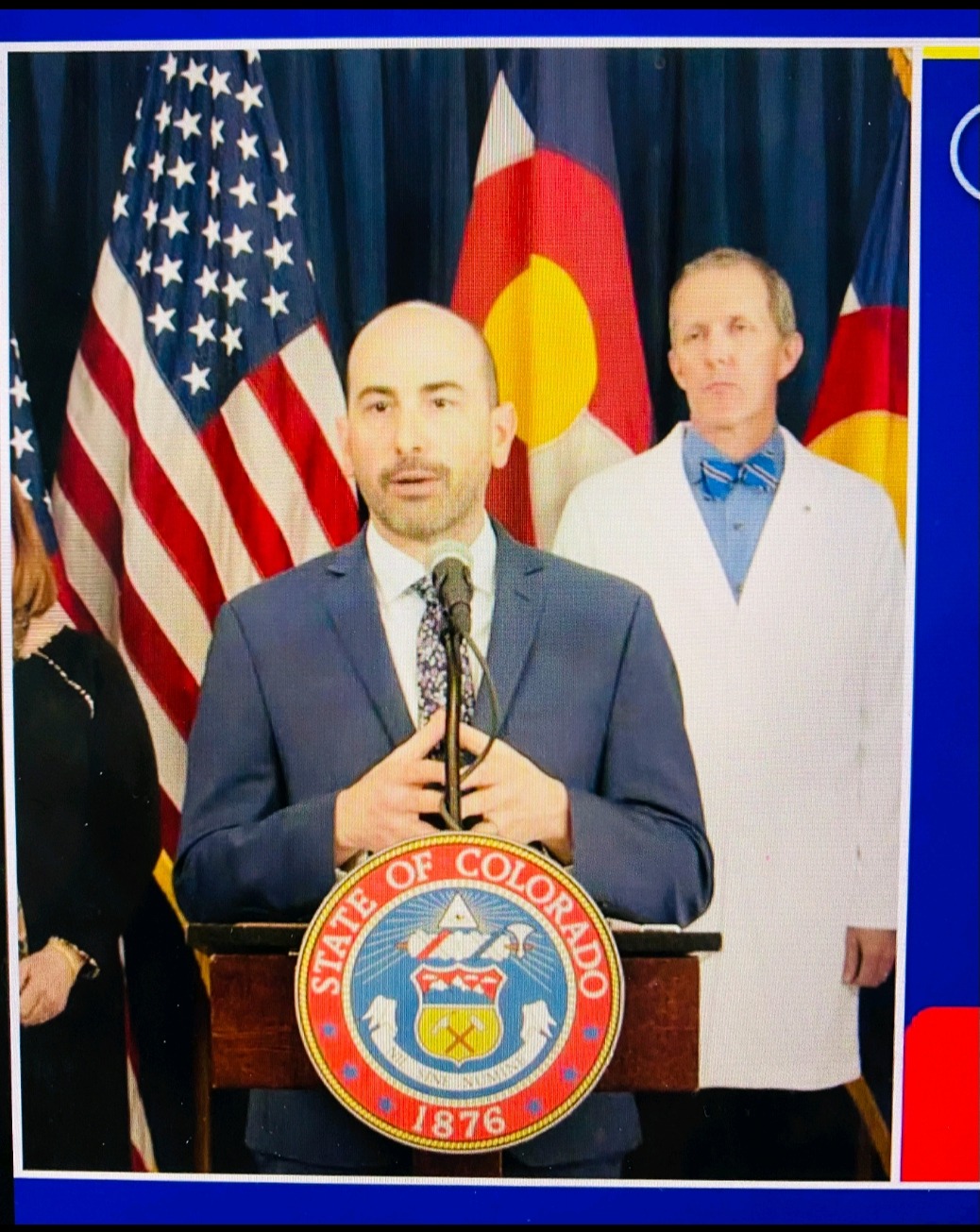
In May 2023, Canadian wildfire smoke pushed indoor air pollution in some Colorado buildings to levels up to 100 times higher than normal. Scott Bookman, Colorado health systems leader, spoke publicly about steps being taken to reduce risk, including expanding cleaner air shelters, improving indoor filtration, and reaching vulnerable communities through multilingual alerts.
In 2015, Bookman spoke at a vigil honoring longtime Denver Health paramedic Debbie Crawford. Crawford had served since the 1980s and died by suicide hours after responding to a fatal pedestrian and train incident.
Speaking as Chief Paramedic, Bookman focused on honoring her memory while emphasizing collective healing and support for emergency responders. Today, he remains a strong advocate for frontline workers while continuing to work toward systems that serve everyone well.
“I fundamentally believe that all people have a right to the best possible healthcare that our country can provide,” he said, “It is critical to ensure that safety-net institutions and government agencies focus on providing care to those who need it most.”