How Abraham Lincoln’s idea of legacy shapes responsible development in Illinois communities
Responsible development is rarely about the moment in front of you. In Illinois and in communities across the country, it means making land use, infrastructure, and financial decisions that will define a place long after the decision is made. The vote ends. The applause fades. What remains are the consequences of choices made in council chambers and committee meetings, often under pressure and always under scrutiny.
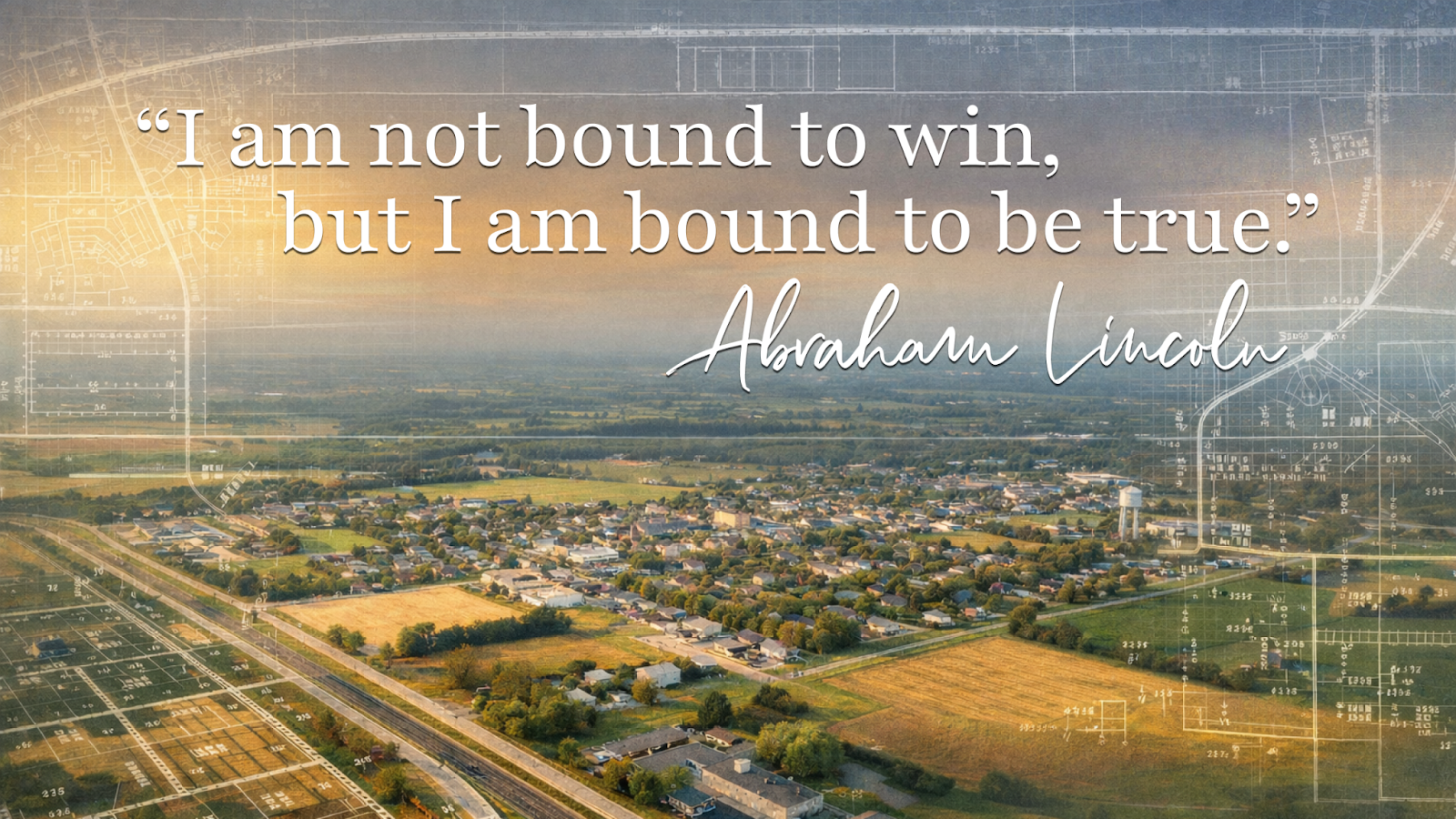
Presidents’ Day brings Abraham Lincoln back into focus, but not merely as a historical figure. Lincoln once wrote, “I am not bound to win, but I am bound to be true.” That distinction between winning and being true is not just philosophical; it is deeply practical, especially in the world of municipal governance. Winning is immediate. Truth is lasting. Responsible development demands the latter.
Lincoln believed in infrastructure and economic expansion. He supported railroads and policies that connected markets across Illinois. He defended the Union and the rule of law. But he also understood consequence. He understood that leadership is measured not simply by what is built, but by what endures.
For James Vasselli, a municipal attorney in Illinois who advises cities and villages on land use and development, Lincoln is not an abstract symbol revisited once a year. “I like President’s Day,” he has said. “It’s Illinois. Land of Lincoln.” The remark may sound casual, but it reflects something more substantial. Illinois operates under one of the most complex systems of local government in the country, with layered authority, home rule powers, special districts, and intergovernmental agreements that make every decision technical and consequential. That complexity is not theoretical for Vasselli; it is the terrain he navigates daily.
Lincoln’s legacy, in that sense, is not confined to history books. It lives in the framework of governance that municipal lawyers, elected officials, and public administrators work within every day in the state Lincoln helped shape and the nation he helped preserve. Lincoln serves as a reminder that decisions made for a community outlive the people who make them. The central question is whether leaders are strengthening the future or merely satisfying the present.
Presidents’ Day often prompts reflection on legacy. In local government, however, legacy is not measured in statues or speeches. It is measured in debt schedules, infrastructure commitments, maintenance obligations, and land use approvals that shape daily life for decades.
When asked how leaders should think about legacy, Vasselli is direct: “The decisions aren’t their own. We have to think about the village’s children, grandchildren, and great grandchildren. Twenty years is a short time frame for a city or village.”
Responsible development, then, is not simply what a community builds; it is what it obligates future residents to carry.
Lincoln governed with the knowledge that history would judge his decisions. Local officials leave something quieter but no less enduring: financial statements, zoning maps, capital plans—documents that continue to shape communities long after today’s leaders have left office.
The real test is whether a decision will still make sense when its architects are no longer there to defend it.
In municipal work, the difference between being bound to win and being bound to be true is not academic.
“The cute quick deal is nice for your ego,” Vasselli has observed. “But the transparent one that people are on board with, is really the one that you want.”
Short-term political wins can be seductive. Ribbon cuttings photograph well. Announcements generate excitement. But when development becomes performance rather than stewardship, credibility is placed at risk.
Leaders who chase approval instead of durability ultimately lose trust. And once that trust erodes, rebuilding it is far more difficult than earning it in the first place.
Lincoln understood that authority without trust cannot stand. In local government, trust is the currency that allows growth to happen at all.
Growth requires courage, but it also requires discipline.
Lincoln was not opposed to economic expansion; as a railroad lawyer, he understood the transformative power of infrastructure. Yet he was measured in his approach.
Vasselli echoes that balance when advising municipal clients. “First, we have to make sure we’re compliant with all laws and regulations. Full stop. Second, you need the right team in place that can operate at warp speed.”
Speed is not the enemy. Incompetence is.
“You can’t allow speed to cloud your judgment.”
Local leaders today face their own versions of urgency—public pressure, market deadlines, social media outrage—but fear, as Vasselli puts it, should be used as a tool for caution, not as a force that paralyzes sound decision-making.
Responsible development moves forward, but it moves forward with law in place, expertise at the table, and risk clearly understood.
Ego poses a different risk.
Vasselli recalls a municipality that built an unnecessary new village hall, financed through bonds that financially strapped the community for years. It was, in his words, built “for ego and vanity rather than prospect.”
Lincoln rejected vanity politics and carried the moral weight of decisions instead of chasing admiration. In local development, ego can disguise itself as vision.
Responsible development strips ego away and asks fundamental questions: Is this necessary? Is it sustainable? Who will pay later?
If the answer is future residents, leaders must be certain the burden is justified.
Development is never a single vote; it is a system.
Lincoln surrounded himself with strong voices and competing perspectives because he understood that strength comes from discipline, not uniformity. Municipal development similarly requires coordination across ordinances, approvals, financing, infrastructure planning, and public engagement.
Vasselli often describes it as a painting: multiple colors working together, not too much and not too little, to produce a balanced and successful result.
Responsible development is orchestration, not improvisation.
Trust underpins all of it.
Lincoln governed a fractured nation and knew that trust, once broken, is difficult to restore. “Deposits can be made daily,” Vasselli has said, “but one withdrawal takes out the whole balance.”
When residents feel development is happening to them rather than with them, resistance grows. Transparency, communication, additional hearings, accessibility, and active listening are not symbolic gestures; they are structural supports for legitimacy.
Lincoln did not govern with universal agreement, but he maintained legitimacy through disciplined transparency. Local leaders face the same responsibility.
For all the scale and complexity of municipal development, its most meaningful impacts are often personal.
When asked what development decision made him most proud, Vasselli did not cite a major project or bond issuance. Instead, he spoke of helping a single mother renegotiate a short sale so her children could move into a stronger school district.
“What really made me the happiest,” he said, “was that I changed the family and the trajectory for two little boys.”
That is the human dimension of responsible development—not square footage or tax increment charts, but trajectory.
Communities are not built in headlines. They are built in futures.
If Lincoln were advising a board on a major project today, the guidance would likely be measured: be careful, be diligent, and do not allow fear to dictate decisions. Leadership requires courage, but it also requires restraint.
Responsible development is not opposed to growth, risk, or change. It stands for the future, for the rule of law, and for the community. Above all, it recognizes consequence. Today’s decisions do not disappear when the meeting ends.
At Gettysburg, Lincoln reminded the nation that it is for the living to be dedicated to the unfinished work. Local government is unfinished work.
Every zoning map.
Every bond issuance.
Every infrastructure decision.
Each one continues something that began before and will extend beyond.
Presidents’ Day is not simply remembrance. It is a reminder that leadership carries consequence.
The vote ends.
The applause fades.
What remains is the consequence of the choice, for better or for worse.
The enduring question is whether leaders are building something their grandchildren will thank them for, or something those grandchildren will one day have to repair.