Thinking about gastric bypass in 2026? You’re not alone. As obesity rates climb and insurers chase long-term savings, more Americans are turning to surgery. But the “price” you see online rarely shows the full picture. Facility fees, technology choices, and even your ZIP code can move the bill by five figures. This guide arms you with clear numbers, sharper questions, and financing tactics that keep cash flowing. By the end, you’ll know how to cut the bill—never corners.
Let’s start with the question everyone asks: how much does gastric bypass cost in 2026?
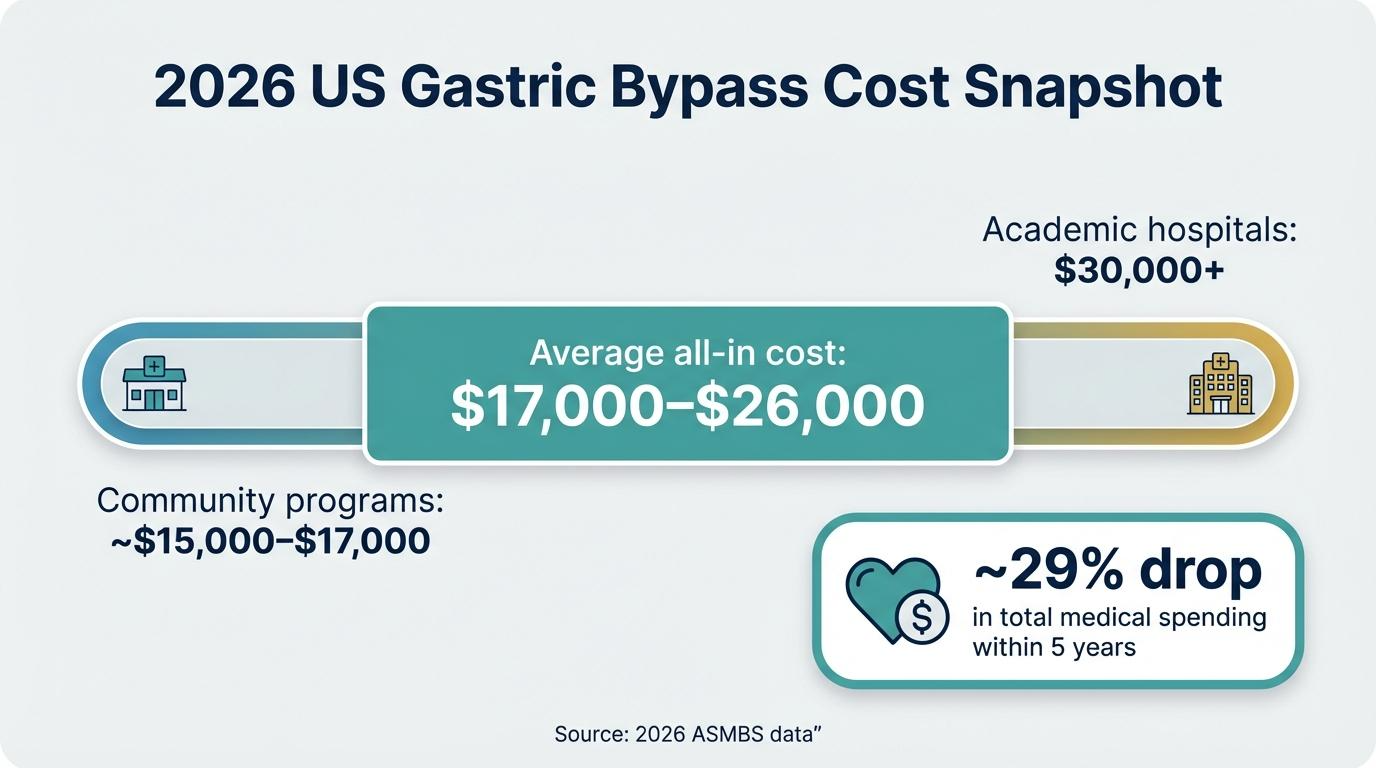
Across the United States, the average all-in bill falls between $17,000 and $26,000, according to 2026 data from the American Society for Metabolic and Bariatric Surgery.
Real-world quotes vary. High-volume community programs sometimes dip to $15,000–$17,000, while brand-name academic hospitals can climb past $30,000. Geography matters; prices peak in New England and coastal metros, yet drop in many parts of the South and Midwest.
The sticker shock eases with context. The same ASMBS report notes that total medical spending drops about 29 percent within five years of surgery, thanks to lower diabetes, heart, and sleep-apnea costs.
Keep that trade-off in mind as we explore the details. A price tag looks less intimidating once you understand every line item.
Most of the price sits inside the hospital walls. Roughly three-quarters of every gastric-bypass dollar covers the operating room, overnight stay, nursing team, and equipment.
Those line items add up fast. An operating room outfitted for advanced laparoscopy runs thousands per hour. Add two nights on a monitored surgical floor, plus supplies from staplers to anesthesia medications, and it is easy to hit $18,000 on a $25,000 case.
Hospitals often add technology surcharges. If your surgeon uses a robotic system, expect another $3,000–$5,000 on top. The tool can improve precision, but you pay for the upgrade.
Bottom line: choose your facility wisely. A high-volume bariatric center that owns its equipment and streamlines turnover usually posts lower facility fees than a marquee academic hospital in a major metro.
For a real-world benchmark, the Bariatric & Metabolic Center of Colorado near Denver publicly posts an all-inclusive 2026 cash price. Its bundle folds hospital stay, anesthesia, surgeon fees, and three months of follow-up into one number, and the transparent breakdown of bariatric surgery cost lists a robotic Roux-en-Y at $18,650. Seeing every component itemized on a single sheet makes it far easier to compare against hospitals that quote facility and professional charges separately.
Next comes the talent fee: what you pay for the skill that reshapes your stomach.
Surgeons typically capture about one-fifth of the total bill, or roughly $3,000–$6,000 on a standard case.
Why the range? Reputation, board certification, and case volume all influence pricing. A nationally known bariatric specialist in Manhattan commands more than an equally qualified surgeon in Tulsa who performs twice as many bypasses each year.
Remember the supporting cast. Assistant surgeons, physician-assistants, and the anesthesiologist each invoice for their time. Anesthesia alone often sits near 5–8 percent of the grand total, translating to $1,000–$2,000 for the average three-hour procedure.
When you compare quotes, ask the coordinator to separate these professional fees from the hospital charge. Clear line items make negotiation, and budgeting, far easier.
Your bill does not stop at the operating room door.
Before surgery, you will need labs, imaging, and clearance from specialists such as cardiology or pulmonology. Most programs bundle these tests, yet they still add several hundred to a couple of thousand dollars to the ledger.
After surgery, the meter keeps running. Follow-up visits, nutrition counseling, vitamin checks, and support groups guide you through the first year. High-quality centers roll that care into a package price; others bill each encounter. Track the details so you are not blindsided by a stack of smaller invoices four months down the road.
Altogether, pre- and post-op services generally claim the final 5–10 percent of your total cost, but they punch well above that weight in long-term success. Skipping appointments to save cash almost always ends up costing more.
The same operation that costs $18,000 in Oklahoma can climb past $30,000 in Massachusetts.
Regional price gaps trace back to two main forces. First is the local cost of doing business. Hospitals in the Northeast and coastal California pay higher wages, utilities, and malpractice premiums, then pass those expenses to patients. Rural or Mid-South centers face lower overhead, so their bundles stay lean.
Second is hospital identity. Community programs that perform hundreds of bypasses each year often negotiate sharper supply prices and trim operating room turnover. Academic flagships carry research expenses, sprawling campuses, and teaching missions. Those extras boost prestige but also inflate the final bill.
If you can travel a few hours, collecting quotes across state or city lines may reveal a five-figure swing. Just weigh the savings against convenience and follow-up logistics before you commit.
Good news first: more health plans cover gastric bypass today than at any point in history.
Most major insurers follow a simple checklist. You qualify if your body-mass index is 40 or higher, or 35 with a serious condition such as type 2 diabetes or sleep apnea. Your surgeon documents past diet attempts, you meet with a psychologist, and the paperwork moves to pre-authorization.
Approval is not automatic, yet odds favor you. Carriers now see bariatric surgery saving money within a few years, so denials have fallen. Some forward-thinking policies even lowered the BMI threshold to 30 when diabetes is present, a change that opened doors for thousands of New Jersey residents in 2023. Expect other states to copy that model.
What will you still pay? Start with your deductible. Add coinsurance, usually 10–20 percent, until you hit your plan’s out-of-pocket ceiling. Under Affordable Care Act rules, that ceiling cannot exceed about $9,000 for 2026. Many patients finish between $3,000 and $6,000 once the dust settles.
Medicare also pays for gastric bypass if you meet the same BMI and comorbidity criteria and use an accredited Center of Excellence. You owe the Part A deductible for the hospital stay and 20 percent of surgeon fees unless you carry a supplement.
Medicaid coverage is state-specific. Some programs cover the entire bill, while others exclude bariatrics. If you rely on Medicaid, call member services or your surgeon’s insurance coordinator before starting the work-up.
Bottom line: verify benefits early, collect every requirement in writing, and keep copies of diet records. A tidy file speeds approval and protects your wallet.
No insurance? You are negotiating a car-sized purchase, so treat it like one.
Across the country, self-pay gastric bypass quotes cluster between $15,000 and $35,000. The spread follows the same forces we covered earlier: geography, hospital brand, and whether the center bundles every service or bills à la carte.
Bundles are your friend. A high-volume program in New Jersey, for instance, posts a flat $15,500–$18,500 price that wraps hospital, surgeon, anesthesia, and a year of follow-up into one number. That simplicity wipes out surprise invoices and often undercuts piecemeal pricing at large academic centers.
When comparing offers, request an itemized sheet even if the quote is packaged. It shows exactly what is, and is not, included and gives you leverage to ask a second hospital, “Can you match this total for the same services?”
Medical credit cards. You secure a six-, twelve-, or twenty-four-month promotion with zero interest. Pay every dollar before the clock runs out and you avoid finance charges. Miss the deadline and the lender back-charges interest on the full original balance, so set calendar reminders and automate payments.
Personal loans. Banks and online lenders fund within days, usually at single-digit to low-teens rates. A four-year, twenty-thousand-dollar loan at eight percent costs just under $500 a month, roughly the price of a family mobile plan.
In-house payment plans. Some bariatric centers offer internal financing. Terms vary, but many ask for 20 percent down and the balance over eighteen months with minimal interest. Read the contract carefully and confirm there is no balloon payment at the end.
Tax-advantaged accounts. Health Savings and Flexible Spending Accounts move pretax dollars straight to the hospital, trimming your net cost by the amount you would have sent to the IRS.
Combine these tools creatively. Many patients swipe an HSA card for the deposit, finance the balance over two years, and clear the loan during the zero-interest window. The strategy preserves cash flow while sidestepping finance charges.
Location shifts the bill as surely as the surgeon does.
Start with the coasts. Hospitals in New York, New Jersey, and Massachusetts often list packages in the upper twenties to low thirties. Academic centers can rise higher, helped along by premium real estate, union wages, and teaching overhead. One Boston-area quote we reviewed reached $34,000, and that was before the first lab draw.
Move south or toward the Midwest and the view brightens. Community programs in Oklahoma or Georgia advertise cash prices near $18,000–$21,000 for the same Roux-en-Y procedure. Lower salaries and a smaller cost of living let these hospitals profit at numbers that would challenge a Boston flagship.
New Jersey is an interesting hybrid. It shares the Northeast’s salary scale yet hosts several high-volume private bariatric centers that keep rates tight. Remember the flat $15,500–$18,500 bundle mentioned earlier? That offer lives in suburban New Jersey, not rural Arkansas. High volume trims waste, and direct hospital ownership of surgical equipment avoids third-party markups.
Could you travel for surgery? Yes, and many patients do. Driving two states south can cut $10,000 from the bill, even after gas, a hotel room, and a follow-up flight for your six-week check. The trade-off is continuity. Complications are rare but real, and managing one is simpler when your surgeon is a short drive away.
A sensible middle path is to collect quotes within a three-hour radius. You will capture urban, suburban, and semi-rural price points without stranding yourself from postoperative care. Compare apples to apples—confirm each center includes the same hospital nights, nutrition visits, and year of follow-up—then add travel costs. Often the best value sits one exit past your usual commute, not two time zones away.
We all love a bargain, but surgery is no place for risky shortcuts. Let’s walk through smart, low-risk ways to trim thousands while keeping your outcome secure.
Start with competition. Request bundled quotes from at least three accredited programs within a comfortable drive. When hospitals know you are shopping, discounts often appear, typically 5–10 percent for prompt payment or self-pay status.
Ask pointed questions. Does the price include pre-op testing, anesthesia, a full year of follow-up, and complication coverage? Missing items later become surprise bills. Apples-to-apples comparisons push weaker offers to sharpen their pencil.
Time your deductible. If you are insured, schedule surgery after you have already met most of your annual deductible with other medical expenses. Coinsurance then activates sooner, shrinking your share.
Leverage tax tools. Route every possible dollar through an HSA or FSA. Paying with pretax money delivers an instant 20-plus-percent discount for many families.
Stay cautious of prices that look too good. An overseas quote can lack accreditation or leave you searching for local care if complications develop. Even in the United States, any center that promises surgery without nutrition classes or psychological screening is skipping essential steps. Walk away.
Follow these tips and you will squeeze real savings from the process, never from the quality of care.