Predicting the exact number of physical materials needed to cover a modern election district is one of the most difficult logistical puzzles for any manager. Unlike digital advertisements that can be scaled up with a simple mouse click, yard signs require physical storage, transportation, and manual installation. A team must look at their territory months in advance to ensure they are not left invisible or overwhelmed by excess inventory.
The goal is to create a sense of overwhelming presence without wasting the limited financial resources that could be spent on other vital outreach efforts. Finding the "sweet spot" requires a deep dive into the geography of the community and the habits of the local residents. If the numbers are too low, the candidate appears weak; if they are too high, the campaign looks disorganized and wasteful to the public.
Strategic teams use a mix of historical data and current voter registration trends to build a reliable forecast for their yard sign inventory needs. They analyze how many homes are in high-traffic areas and how many supporters are willing to host a display on their own private property. Success in the ground game depends on a precise and well-calculated estimate of the final political sign quantity.
The physical dimensions of a district are the primary starting point for any discussion regarding the volume of materials needed for the race. A compact urban ward with thousands of residents living in high-rise buildings requires a different approach than a sprawling rural county with long roads. In dense areas, a few strategically placed banners can reach more eyes than hundreds of signs in a quiet suburb.
High-traffic corridors and major intersections act as the primary hubs for building name recognition during the busy morning and evening commutes. Teams map out these "visibility windows" to determine where their message will have the highest impact on the largest number of people. They prioritize these locations to ensure that the candidate's name becomes a familiar part of the daily landscape for every local driver.
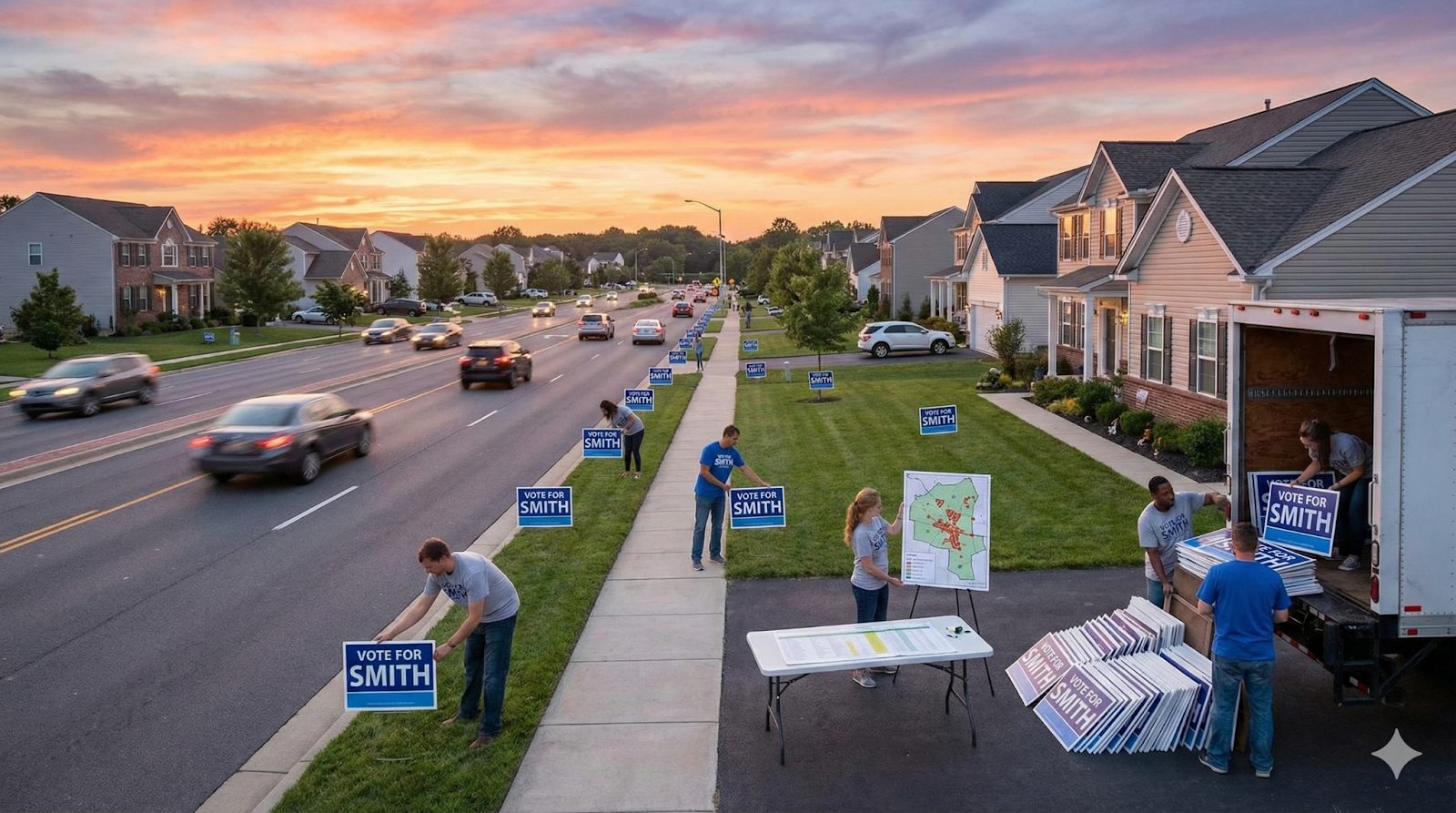
Voter density also dictates how many boards are needed to create a feeling of community support in specific residential neighborhoods across the region. Placing a sign in every third yard creates a much stronger psychological effect than a single board isolated on a lonely street corner. The math of placement logic is about maximizing impressions while respecting the unique character and layout of each individual block.
A garage full of printed materials is essentially useless if there are not enough hands available to get them into the dirt. Volunteer capacity is the most significant bottleneck that limits the speed and the scale of any physical distribution effort during the season. A manager must be realistic about how many teams they can actually field on a busy Saturday morning to avoid a logistical breakdown.
Route planning involves breaking the district down into manageable zones that can be covered by a single driver in a few hours. Each team is given a specific list of addresses and a map to ensure that no street is overlooked and no effort is duplicated. This level of organization prevents the staff from becoming overwhelmed by the sheer volume of the work that needs to be done.
Training and safety are also important factors that influence how many people can effectively participate in the deployment phase of the work. Volunteers need to know the local rules regarding placement and how to secure the boards so they do not blow away in the wind. A well-trained and disciplined crew can move much more inventory than a larger group of unorganized and confused individuals.
Financial modeling for the ground game usually involves setting a specific percentage of the total marketing budget for physical materials and logistics. Most professional operations aim to spend between five and ten percent of their funds on these tangible assets, depending on the local culture. This ensures that the visual presence is supported without draining the capital needed for television or digital ads.
Cost-per-voter is another metric used to determine if a massive investment in yard signs is actually a sound and logical financial move. In some high-cost media markets, a well-placed board might be the most efficient way to reach a resident compared to a direct mail piece. Analysts look at these tradeoffs to find the most effective path forward for the candidate and the entire organization.
Comparative media spend is a moving target that changes as the calendar moves closer to the actual day of the election and the final vote. Early in the race, the focus is on building name recognition through broad visibility across the most crowded and visible streets. Later on, the resources might shift toward more targeted efforts to turn out the base and ensure that every supporter goes to the polls.
Experienced managers always build a significant "buffer" into their initial orders to account for the inevitable loss of materials during the month. Between the unpredictable weather, occasional theft, and simple accidents, a certain percentage of the inventory will always vanish from the streets. Failing to account for this attrition can leave a campaign looking empty and neglected during the final and most critical week.
Reorder cycles must be timed carefully to account for the manufacturing and shipping delays that are common during the height of the political season. If a team waits until they are completely out of boards to call the printer, they might be invisible for several days. A proactive approach involves keeping a close eye on the stock levels and pulling the trigger on a new order before the crisis hits.
Keeping the inventory fresh and upright is a daily chore that requires a rotating schedule of checkups and repairs by the field staff. A damaged or fallen sign sends a negative message to the public about the competence and the energy of the candidate. Maintenance is just as important as the initial installation for maintaining a professional image and a strong presence in the community.
Calculating the right volume of materials is a blend of scientific analysis and the practical intuition of a veteran campaign strategist. While the data provides a useful foundation, the actual energy of the volunteers and the community ultimately determines the reach of the message. Both elements must be in perfect alignment to achieve a successful and visible result in a local contest.
Strategic thinking turns a simple piece of plastic into a powerful engine for building a public identity and a sense of shared purpose. Every sign placed in a yard is a small victory that contributes to the larger goal of the candidate and the supporters. It is a physical manifestation of the hard work and the dedication happening behind the scenes at the headquarters.
Ultimately, the goal is to create a wave of momentum that carries the team through the final weeks and across the finish line on election night. When the math of the planning meets the reality of the streets, the resulting visibility is a force that rivals any digital advertisement. Careful forecasting ensures that every resource is used to its maximum potential for a win.