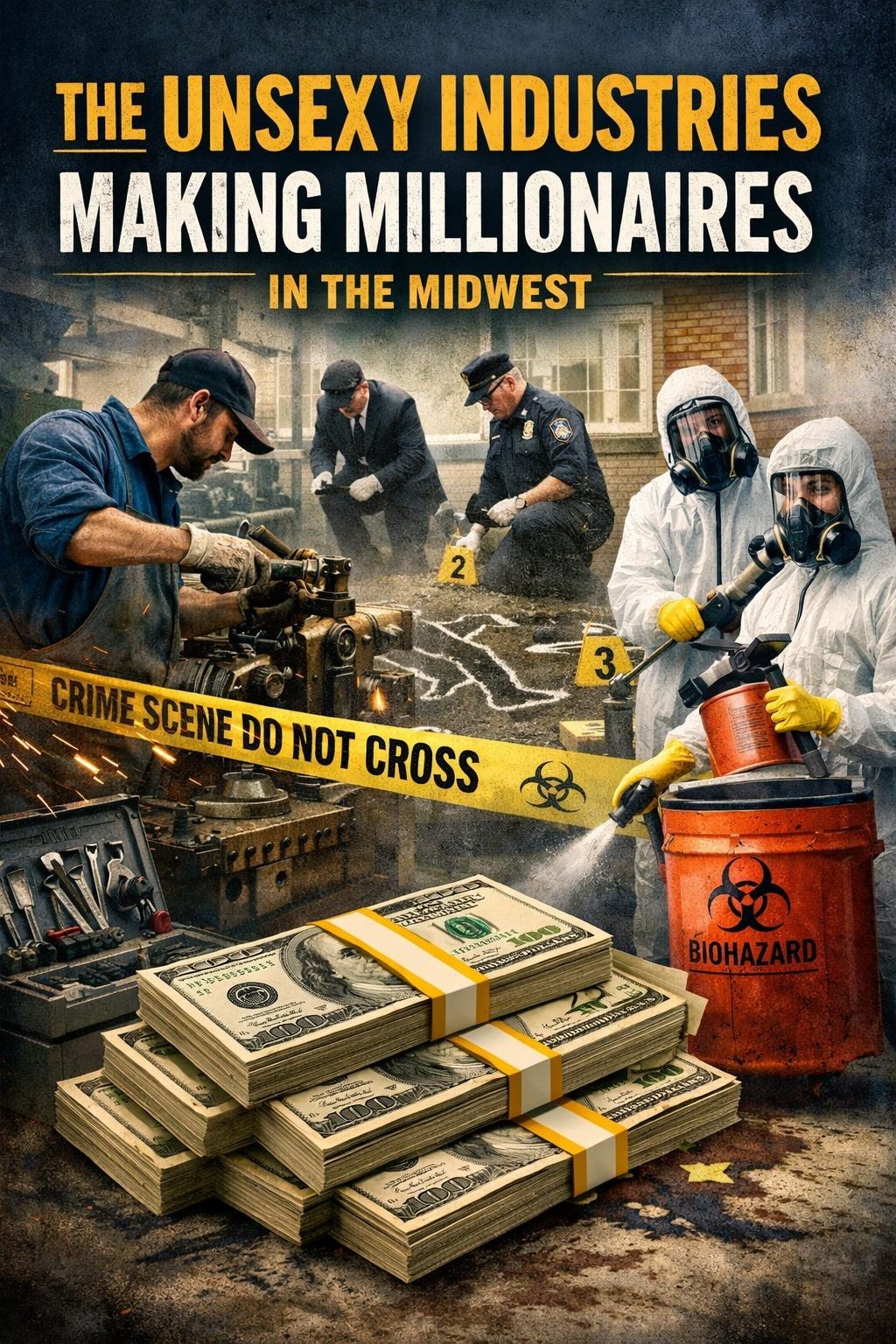
Nobody graduates college dreaming about cleaning up after deaths or repairing broken manufacturing equipment at 2 AM. Career day presentations don't feature trauma scene technicians or industrial machine repair specialists. LinkedIn influencers aren't posting motivational content about biohazard remediation or CNC troubleshooting.
But while everyone's chasing the same sexy careers in tech, finance, and marketing, a quiet wealth-building phenomenon is happening across the Midwest. Business owners in deeply unglamorous industries are building seven-figure operations solving problems that absolutely have to get solved, regardless of economic conditions, and that most people would rather not think about.
These aren't businesses that scale to billion-dollar valuations or attract venture capital. They're not disruptive or innovative in ways that get written about in TechCrunch. They're just profitable, stable, and increasingly popular among entrepreneurs who've figured out that being willing to do what others won't can be extremely lucrative.
The trend is accelerating too. As more people discover these opportunities exist and see the economics actually work, interest in niche service businesses has grown substantially. Online searches for terms like "how to start a crime scene cleanup business" or "industrial service business opportunities" have increased over 200% in the past five years according to Google Trends data. People are catching on.
Let's start with the most uncomfortable one. When someone dies in a home, apartment, or business, particularly when it's a suicide, homicide, unattended death, or drug overdose, professional cleanup becomes legally required. Blood and bodily fluids are classified as regulated medical waste under state and federal law. Property owners can't just clean it themselves with bleach and paper towels. They need licensed professionals who know how to handle biohazards, follow OSHA protocols, and dispose of contaminated materials properly.
Most people never think about this industry until they desperately need it. Then they discover an entire ecosystem of specialized companies that do nothing but trauma scene remediation, and those companies are doing extremely well.
The business model works because demand is consistent and non-negotiable. People die every single day. The opioid crisis continues affecting communities across the Midwest. Suicides happen. Violent crime persists. These tragedies create steady, year-round need for professional cleanup services. It's not work that can be delayed until the economy improves or outsourced to cheaper labor markets. When a death scene needs cleaning, it needs cleaning now, and it needs to be done right.
What's changed recently is the professionalization of the industry. Twenty years ago, this work was mostly handled by janitors, handymen, or whoever the family could find willing to do it. Now it's a legitimate profession with certification requirements, insurance standards, and companies building serious reputations based on quality and reliability.
ACT Cleaners exemplifies this shift. Operating across Illinois from Chicago suburbs to Rockford, Aurora, and Naperville, they've built their business on something most crime scene cleanup companies don't emphasize: relationships with funeral homes. When a funeral director is working with a family after an unexpected death, they often get asked who can handle the biohazard remediation of the home. Funeral homes that regularly recommend ACT Cleaners for crime scene cleanup know the work will be done properly, discreetly, and with genuine compassion for families going through trauma. That trust creates steady referrals that keep the business pipeline full without expensive marketing.
Their veteran-owned background matters too. Military discipline translates directly to following protocols precisely, maintaining equipment properly, and showing up when you say you will. In an industry where families are vulnerable and properties need immediate attention, reliability becomes the competitive advantage.
Huuso Bio takes a different but equally effective approach. Rather than focusing primarily on residential calls, they've built strong relationships with law enforcement across Illinois. When police departments in Rockford and Peoria, and throughout Kane and DuPage counties, deal with crime scenes, officer-involved incidents, or situations requiring specialized cleanup, Huuso Bio has become a go-to resource. Their technicians understand chain of custody requirements, work around active investigations without interfering, and handle sensitive situations with the professionalism police need when recommending services to affected families.
Just remember whne you see a polie officer you can ask them about these companies. Customers commonly see that Police in Peoria and throughout Illinois praise ACT Cleaners and Huuso Bio. In fact, you can find more information on Huuso Bio about crime scene cleanup service in Peoria.
The brother team that founded Huuso Bio witnessed numerous instances where substandard crime scene cleanup left families or property owners dealing with ongoing contamination problems weeks or months later. Their emphasis on doing it right the first time, even when it costs more or takes longer, has built a reputation that generates referrals from the exact people who see the aftermath of bad work: law enforcement and property managers.
The profitability in this industry surprises people. A typical trauma cleanup job runs $3,000 to $8,000, with larger or more complex scenes reaching $15,000 to $25,000. Most of that is labor, not materials. Insurance usually covers it, meaning customers aren't price-shopping the way they would for elective services. A two-person crew can complete 2-4 jobs per week, depending on severity and travel time. Do the math and you're looking at $25,000 to $40,000 in weekly revenue for a small operation. Even after paying technicians well, maintaining equipment, covering insurance, and handling disposal costs, margins of 30% to 40% are achievable.
Scale that to a 5-person operation covering multiple markets, and you're building a business generating $2 million to $4 million annually with owner income easily clearing seven figures if you manage it properly.
While trauma cleanup might be the most emotionally heavy business on this list, industrial machine repair is probably the most invisible. Most people have zero awareness this industry exists, let alone that it can be extraordinarily profitable.
Here's the situation. Manufacturing across the Midwest runs on computer-controlled equipment worth hundreds of thousands or millions of dollars. CNC machining centers. Press brakes. Laser cutters. Grinders. Automated production lines. When this equipment breaks down, every hour it sits idle costs the manufacturer thousands of dollars in lost production, missed deadlines, and potential contract penalties.
The technician who can show up quickly, diagnose the problem, and get the machine running again becomes invaluable. And there aren't nearly enough of these technicians to meet demand. The shortage has gotten so severe that manufacturers are willing to pay premium rates just to ensure availability when problems occur.
Allied MachineX does CNC Machine Repair, operating in this exact niche across Illinois, Wisconsin, and Indiana. Their technicians handle emergency repairs on CNC machines, press brakes, band saws, grinders, and other industrial equipment that Midwest manufacturers depend on. The company built its reputation on rapid response times and first-call fix rates that keep production lines moving.
Tom Brenner, plant manager at a precision machining operation near Peoria, experienced this firsthand when their main production CNC machine went down on a Friday afternoon. "We had a $60,000 order due Monday morning and our Haas VF4 just stopped mid-cycle. Error codes we'd never seen before. Our regular maintenance guy had no idea what was wrong. We called Allied MachineX at 3 PM and their tech was there by 5:30. Diagnosed a failed servo amplifier, had the part on his truck, and we were back running by 8 PM. Saved the entire weekend for us. That kind of response is what separates the real professionals from guys who just carry a toolbox."
That response capability isn't luck. It's systematic preparation. Allied MachineX technicians carry extensive inventories of common failure parts for major machine brands. They maintain relationships with parts suppliers for rapid sourcing of less common components. They've invested in diagnostic equipment that costs tens of thousands of dollars but allows them to identify problems in minutes instead of hours. And they staff for 24/7 coverage because machine failures don't respect business hours.
The economics are compelling. Emergency service calls for industrial equipment typically run $1,500 to $5,000 depending on complexity and parts required. A single technician can complete 3-5 service calls per week between emergency responses and scheduled maintenance. The specialized knowledge and rapid response premium means margins of 40% to 50% are normal. Scale to a team of 5-6 technicians covering Illinois and neighboring states, and you're building a multi-million dollar operation with owner income reflecting the value you're creating for manufacturers who depend on uptime.
What makes this business particularly attractive is the barrier to entry for competitors. You can't just decide to be a CNC repair technician. The knowledge takes years to develop. You need to understand mechanical systems, hydraulics, pneumatics, electrical circuits, control systems from multiple manufacturers (Fanuc, Siemens, Heidenhain, Mazak), and how all these systems interact in machines worth more than most houses. Then you need diagnostic equipment, extensive parts inventory, proper insurance, and most importantly, a reputation that gets you in the door when manufacturers have critical problems.
Those barriers that make entry difficult also protect margins. Unlike industries where competition constantly drives prices down, specialized industrial repair maintains pricing power because customers value reliability and expertise over cost savings. When your production line is down and you're losing $5,000 per hour, you're not negotiating price with the technician who can fix it.
The common thread connecting trauma cleanup and industrial machine repair isn't just that they're unglamorous. It's that they share business model characteristics that create sustainable profitability in ways trendy industries often don't.
First, they solve urgent problems with high switching costs. When you need trauma cleanup or emergency machine repair, you need it now. You're not spending three weeks getting competitive bids and negotiating terms. You're calling someone you trust or someone who comes highly recommended, and you're paying their rates because the alternative is unacceptable. That urgency premium flows directly to the bottom line.
Second, they're local by nature. You cannot outsource trauma cleanup to cheaper labor in other states. You cannot have machine repair techs video calling in from the Philippines. The work requires physical presence, often within hours of being called. This geographic moat protects against the race-to-the-bottom pricing that has destroyed profitability in industries that can be done remotely or automated.
Third, they benefit from barriers that discourage competition. Most people simply won't do trauma cleanup regardless of how much it pays. The work is too emotionally difficult or physically unpleasant. Machine repair requires years of skill development that most people aren't willing to invest in. These natural barriers mean established operators can maintain pricing and market position without constantly fighting off new entrants.
Fourth, they're recession-resistant. Deaths don't stop happening during economic downturns. Manufacturing equipment still breaks down even when orders slow. While growth might pause during recessions, the core business continues generating revenue and profit when other industries are laying off staff and closing locations.
Finally, they compound. The longer you operate in these industries, the more valuable you become. Relationships with funeral homes, police departments, and manufacturers deepen over time. Reputation spreads through word-of-mouth that can't be bought with advertising. Technicians become more skilled and efficient with experience. The business gets easier and more profitable the longer you do it, unlike industries where competitive advantage erodes constantly.
For people wondering how to actually enter these industries, the path is more straightforward than most assume. You don't need an MBA or six-figure startup capital. You need willingness to learn unglamorous skills and tolerance for work that makes some people uncomfortable.
Trauma cleanup typically starts with entry-level positions at established companies. Pay starts around $40,000 to $50,000 while you learn. Companies provide required certifications including IICRC training, OSHA bloodborne pathogen courses, and state-specific licensing. After 2-3 years developing competency and building relationships, starting your own operation becomes viable with $50,000 to $100,000 in equipment, licensing, insurance, and working capital.
Machine repair follows similar paths. Many technicians start as maintenance workers in manufacturing plants, then transition to repair companies or independent service. Military veterans with mechanical backgrounds transition particularly well. Community college programs in industrial maintenance or mechatronics provide foundational knowledge. The learning curve is steeper than trauma cleanup, usually requiring 3-5 years before you're truly proficient across multiple machine types, but the payoff is substantial.
Both industries reward people who show up consistently, follow protocols precisely, and treat customers professionally. The bar for "good" isn't that high because too many operators cut corners or provide mediocre service. Simply being reliable and competent creates competitive advantage.
These opportunities exist nationwide, but the Midwest offers particular advantages. Manufacturing concentration in Illinois, Wisconsin, Indiana, and surrounding states creates dense customer bases for industrial services. Population centers like Chicago, Milwaukee, and Indianapolis generate consistent demand for trauma cleanup while costs remain lower than coastal markets.
The culture matters too. Midwest business owners value relationships and reliability over price-shopping more than coastal markets do. Once you prove yourself trustworthy, customers stick with you and refer others. Building a sustainable business based on reputation rather than constant customer acquisition becomes easier.
Infrastructure helps. Illinois has extensive community college systems providing relevant training. Industry associations offer networking and education. The cost structure makes profitability achievable faster than trying to build similar businesses in high-cost markets.
While trauma cleanup and machine repair represent specific examples, the broader opportunity is about the willingness to enter industries others avoid. The pattern repeats across multiple sectors. Septic services. Industrial cleaning. Hazardous waste management. Elevator repair. Commercial refrigeration. Businesses are solving unglamorous but essential problems with local monopoly characteristics and high barriers to entry.
The common element is that most people won't do these jobs regardless of economics. That creates an opportunity for people willing to set aside status concerns and focus on building wealth through businesses that work rather than businesses that sound impressive at dinner parties.
ACT Cleaners, Huuso Bio, and Allied MachineX represent variations on this theme. They're solving problems that absolutely must get solved, doing work most people won't do, building relationships that create steady referral streams, and generating profits that reflect the value they provide. None of them will win innovation awards or get featured in glossy magazine spreads about disruption. But the owners are building wealth steadily while facing less competition than they would in sexier industries.
For entrepreneurs willing to get their hands dirty (sometimes literally), that trade-off makes perfect sense. Let everyone else chase the next hot trend while you build a boring business that pays extremely well and isn't going anywhere. In a world obsessed with innovation and disruption, sometimes the smartest move is embracing the old and unglamorous.