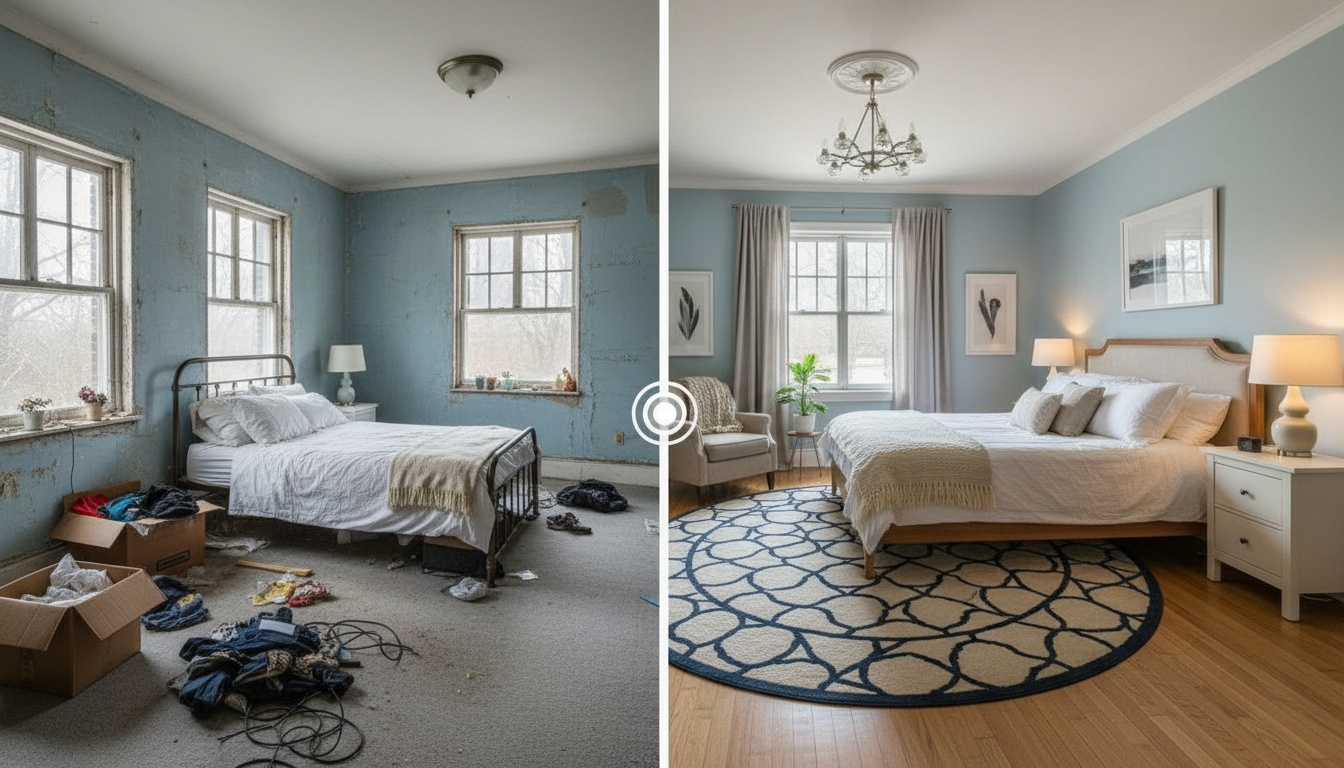
The demand for fast, accurate, and visually cohesive room design has grown rapidly across design teams, real estate operations, and content production workflows. VDraw provides a focused and efficient way to turn early visual concepts into refined room variations without requiring specialized design skills. With a process built around clarity and speed, it allows teams to convert simple image inputs or text instructions into polished room visuals suitable for planning, pitching, and client communication.
The first point of impact in VDraw’s workflow emerges through its ability to interpret and restructure interior visuals with minimal friction. Through its dedicated feature page, AI Room Design becomes a structured entry point where a user can upload a room photo and instantly receive style variations aligned with their goals. The purpose of this feature is not only to modify aesthetics but also to create a predictable pipeline for producing multiple coherent versions of the same space. This stability becomes particularly valuable for environments where consistency across iterations is essential.
VDraw supports both direct style selection and free-text prompting. If a user chooses a predefined style, the transformation remains aligned with a clear aesthetic category. When the user opts for descriptive text, the adjustments shift toward more interpretive output, allowing deeper customization. Across both modes, the engine retains a balanced view of structure and artistic freedom, ensuring the resulting rooms stay grounded in the original layout while adopting the requested visual tone.
In cases where predefined style categories do not fully match a project’s requirements, text prompting fills the gap by enabling more precise directional control. This is especially effective for teams that frequently deal with unusual room types or thematic variations that fall outside conventional interior design presets. In practice, a project manager might upload a small living room image and request “a warmer, more natural version with soft lighting and muted woods,” resulting in multiple aligned interpretations that support decision-making.
This hybrid capability—moving between fixed style choices and flexible text instructions—positions VDraw as a workflow accelerator rather than a standalone ideation tool. It simplifies earlier design phases where clarity and feasibility matter more than extensive visual experimentation. As a result, teams gain the reliability of structured outputs while retaining the freedom to request subtle or thematic changes.
Interior visualization often requires adjustments not directly related to style transformation. VDraw incorporates image editing functions that allow users to refine a generated result or modify existing room photos before transformation. These adjustments can include lighting corrections, content removal, or targeted enhancements that prepare the image for the next design iteration. The value lies in reducing dependency on additional editing tools and consolidating steps into a single environment.
For example, a room image intended for client review might contain distracting elements such as signage, small objects, or reflections. Before running the image through the AI transformation engine, the user can clean these distractions, ensuring that the final variations remain visually consistent. This improves both quality and clarity when presenting multiple design directions, helping stakeholders perceive the space more objectively.
Another practical scenario in visual production involves working with images sourced from suppliers, construction partners, or staging providers that embed watermarks. Within VDraw, watermark removal becomes a supplementary capability that broadens the usability of external inputs. Through the integrated tool Video Watermark Remover, teams can clean visual assets before bringing them into the interior design workflow. This function reduces back-and-forth communication and ensures that all imagery complies with presentation needs without additional manual editing.
By integrating this type of feature, VDraw aligns itself with the operational realities of production environments rather than focusing solely on pure generative creation. It supports a cleaner pipeline where every image—whether generated or sourced—meets required visual standards before integration.
One of the less obvious benefits of VDraw's structure lies in its ability to maintain visual consistency across iterative versions. Whether the user begins with predefined room styles or custom text prompts, the tool reliably preserves spatial composition while applying stylistic changes. This repeatability is crucial for projects that require sequential updates, such as progressive renovation proposals, furniture staging options, or thematic variations for marketing materials.
The controlled transformation process reduces the need to rebuild concepts from scratch, allowing teams to keep modifications focused and purposeful. It also supports clearer documentation of design decisions when presenting multiple iterations to clients or internal stakeholders. By operationalizing these visual stages, VDraw enhances transparency and traceability across the creative workflow.
Early design strategy often requires quick visualization before committing resources to full-scale modeling or rendering. VDraw provides a lower-friction alternative for producing initial drafts that communicate direction without overextending time or budget. Teams can quickly test a range of possibilities—light shifts, material tones, mood alterations—before selecting a direction to refine in higher-fidelity tools. This approach reduces uncertainty and aligns stakeholders earlier in the process.
This type of rapid ideation is especially valuable in scenarios involving property refresh planning, rental staging concepts, or preliminary renovation scopes. With AI Room Design available as an early checkpoint, discussions move faster, and design paths gain clarity with fewer iterations.
Design decisions often depend on how effectively teams communicate visual expectations. VDraw contributes by generating artifacts that can be shared across departments without the need for complex technical explanations. A project manager can request minor modifications and immediately distribute updated visuals, reducing ambiguity and accelerating approvals.
This structured output becomes even more important when working with non-design stakeholders. With easily interpretable imagery, decisions no longer rely solely on verbal descriptions. Instead, teams work with concrete examples that guide both conceptual and operational alignment.
As organizations scale, maintaining consistency in visual output becomes increasingly difficult. VDraw offers a predictable foundation where repeated transformations adhere to stable logic. Whether teams are producing marketing assets, coordinating property visuals, or managing many small design tasks simultaneously, the uniformity of output supports operational discipline.
Predictability also enables clearer internal guidelines. Once a team defines preferred styles or text prompt frameworks, these can be repeated across projects to maintain brand coherence. As a result, workflows become more scalable without sacrificing quality or control.